
Latest Blog Posts

AI Early LiteracyAI Pre-LiteracyAI Pre-Literacychild-robot interactionearly childhood AIEducationevidence mapopen scienceresearch infrastructure
AI Pre-Literacy Research Observatory: An Open Evidence Map for Researchers
If you are planning a study, writing a review, positioning a grant, or looking for a gap, the Observatory shortens ...

Ages 2-7AI Early LiteracyAI LiteracyAI Pre-LiteracyAI Pre-LiteracyChild DevelopmentDigital ParentingEarly ChildhoodEducationParenting in AI AgePlay-Based Learning
AI Literacy Is Essential — And It Assumes Your Child Is Already 8. What About Age 2–7?
A four-year-old told her mother that Alexa was her friend. Her mother asked me if that was a problem. Most ...

AI Early LiteracyAI LiteracyAI Pre-LiteracyAI Pre-LiteracyChild Developmentcritical thinkingDigital ParentingEducationParentingParenting in AI Age
Why AI Literacy Gives Your Child an Edge — From Prompting to Creating to Questioning
A father's son used ChatGPT for a science project. The teacher gave him a C. "He can use AI," the ...
AI Pre-LiteracyChildren and Technologycritical thinkingDigital LiteracyDigital NativesInformation LiteracyParenting in AI AgeSearch Engine LiteracySearch EnginesUNESCO AI Framework
Digital Literacy and the Search Engine Child: Why Finding Isn’t Understanding
A teacher asked her 10-year-old student how he knew his search result was reliable. "It was the first result," he ...

AI and ChildrenChild DevelopmentCollaborationComputer Literacycritical thinkingEducationEmpathyFoundation SkillsSelf-Regulation
Why Computer Literacy Is Not Enough Anymore—But We Still Need Its Discipline
A child types a perfect prompt into an AI tool. The AI generates a flawless essay. No struggle. No frustration ...

From Silence to Voice: The BUNYAAD Framework is Now Live!
We are thrilled to announce the launch of the BUNYAAD Framework — a zero-cost, culturally-rooted, and evidence-based framework designed to ...
abstractionAI Pre-Literacyalgorithmic thinkingchild cognitive developmentcoding classescomputational thinkingdebugging gamesdecompositionLogo Turtleno computer gamespattern recognitionSeymour Papertunplugged coding
The Logo Turtle and the Birth of Thinking: How Computer Literacy Tried to Teach Children to Think
In 1967, a small robot called the Turtle taught children to program. But it was never about coding. It was ...

AI literacy foundationAI Pre-LiteracyAI Pre-Literacycomputer literacy for kidsevolution of literacyfrom computer literacy to AI literacyhistory of digital literacyomputer literacySeymour Papert
What Was Computer Literacy? Why Knowing Parts of a Computer Was Once Enough
In 1985, if your child knew what a floppy disk was, she was computer literate. That was not small. It ...
AI LiteracyAI literacy for kidsAI Pre-Literacyalgorithmic persuasionbias in AIchild AI educationcognitive offloadingcompetence understanding gapcritical thinkinghallucinationParentingParenting in AI Ageprediction vs knowledgeprobabilitytraining datauncertainty
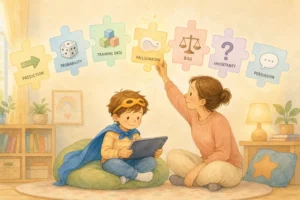
The Competence–Understanding Gap: Your Child Knows How to Use AI— But Does Your Child Understand It?
A child can be brilliant at using AI and still have almost no idea how it works. That is the ...

attachment repairchild resiliencecontribution ritualfamily identityfamily ritualsfamily storiesidentity fortressintergenerational storiesParentingParenting in AI Agerepair ritualsense of belonging
The Identity Fortress: Three Family Rituals AI Can Never Replace
AI can be a tutor, a playmate, an answer machine. It cannot give your child a sense of who they ...
The Guessing Machine – A Five-Minute Exercise to Demystify AI for a Six-Year-Old
Today I share the 5-minute game I play with a 6-year-old to teach this — no apps, no prep, just ...

Raising a Code-Breaker, Not a Code-User: Three Algorithmic Thinking Games With No Computer
Don't just teach kids to code. Teach them to break code. Three simple games with no computer — Buggy Recipe, ...
The Oracle Child: When Children Start Treating AI as an Authority
AI answers with fluency and confidence, which children can mistake for accuracy. Teaching critical AI literacy — checking sources and ...

The Empathy Muscle: 5 Daily Practices to Keep Empathy Human When AI Always Agrees
Empathy is not taught by lecture. It is built like a muscle — through repeated, effortful, real practice where action ...

The Empathy Vacuum: What Children Don’t Practice When AI Always Agrees
She tells AI: 'My friend was unfair.' AI says: 'You did nothing wrong.' She feels better. Next day her friend ...

AI and ChildrenCaregivingChild DevelopmentCompassionate EmpathyDigital ParentingHelpingParentingProsocial Behavior
Doing For Others: Why Compassionate Empathy Needs Real Need
Your child waters a plant. The leaf lifts. No points, no praise — the plant simply lives better. That is ...

Affective EmpathyAI and ChildrenAI LiteracyChild DevelopmentDigital ParentingEmotional ResonanceFace ReadingParenting
Feeling With Others When the Other Never Feels Tired: Why Affective Empathy Needs a Human Face
AI is the un-tired other — always calm, always available. Real empathy grows when a child notices a tired face, ...

AI and ChildrenAI LiteracyAI Pre-LiteracyChild DevelopmentCognitive EmpathyParentingPerspective TakingTheory of Mind
Thinking With Others in an AI World: Can AI Teach Perspective-Taking?
Your child asks AI: 'What is my friend thinking?' AI gives a perfect paragraph. No pause needed. But real perspective-taking ...

AI and ChildrenAI Pre-LiteracyAlgorithmic InfluenceBeauty FiltersBody ImageChild DevelopmentDigital ParentingIdentity DevelopmentParentingParenting in AI AgeSelf-ImageSocial MediaSynthetic Mirror
The Synthetic Mirror: How Algorithmic Mirrors Are Reshaping Children’s Self-Image
A 14-year-old looked in a real mirror and burst into tears: 'This isn't me. My real face looks wrong.' She ...

AI and ChildrenAI LiteracyAI Pre-LiteracyChild DevelopmentDigital ParentingIntrinsic MotivationParentingParenting in AI AgeProductive StruggleResilience
Why Does My Child Give Up So Easily? AI, Instant Answers, and the Loss of Productive Struggle
A 10-year-old stares at math for 30 seconds then says 'Just tell me!' Why children who grow up with instant ...