
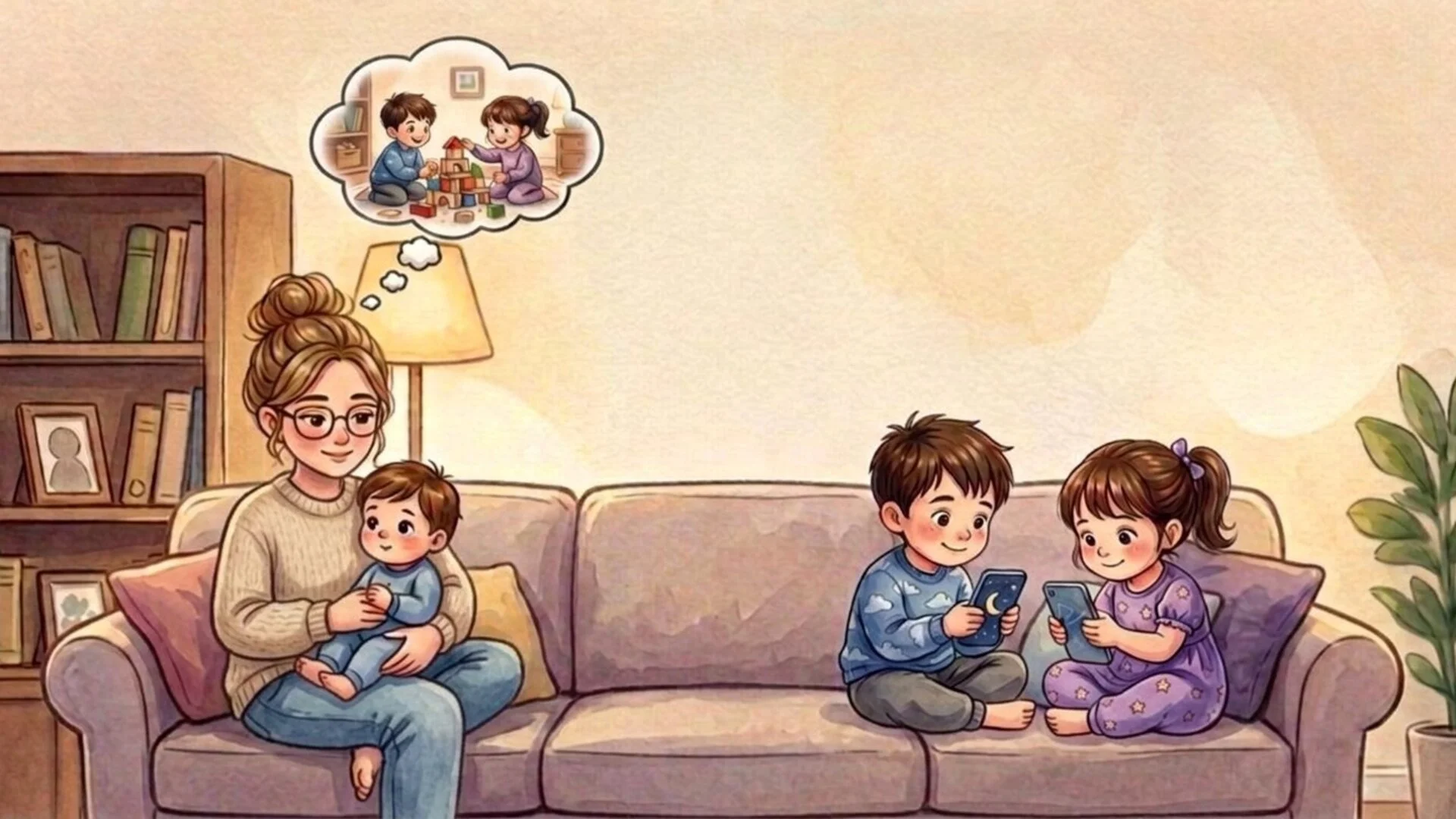
Something is happening in your child’s life right now that will shape how she thinks about technology for the rest of her life. It is happening quietly. It is happening long before any classroom lesson about computers. And most of it is happening in your home.
By the time a child turns eight, she has already formed a set of assumptions about what machines are, whether they can think, whether they can be trusted, whether they care, and whether their decisions are fair. These assumptions will shape everything she does with technology as an adult — how she questions what she reads, whether she can tell a person from a simulation, whether she understands that someone, somewhere, made the system she is using.
We call this territory AI Pre-Literacy. We coined the term because there was no word for it, and because we believe parents and educators need one.
What AI Pre-Literacy Means
Here is the formal definition:
AI Pre-Literacy is the developmental territory from birth to approximately eight years in which young children encounter, notice, represent, interpret, discuss, orient toward, and respond to artificial intelligence and AI-mediated phenomena — forming the linguistic, cognitive, affective, empathic, and socio-ethical foundations upon which later AI literacy, critical evaluation, and responsible participation may develop, within the dynamic social, cultural, linguistic, technological, familial, educational, and community ecologies of childhood.
That is a mouthful. Here is the plain version: the years from birth to eight are when your child builds the mental and emotional foundations for understanding AI. Not the technical knowledge. The foundations. The instincts. The vocabulary. The early sense of what is a person and what is not.
Why “Pre” Means “Prime,” Not “Before”
Most people hear “pre” and think “before.” Pre-school. Pre-reading. Pre-anything. The prefix sounds like a waiting room — a period when a child has not yet arrived at the real thing.
We mean something different. We mean prime — the first, foremost, formative years. The years when the foundations are laid. The years when what is learned is learned most deeply, most permanently, most invisibly.
The years from birth to eight are not a waiting room. They are the construction site.
A child’s brain in these years forms more neural connections than it ever will again. Language is acquired at a rate that will never be matched. The sense of self, of other people, of fairness, of what is real — all of these are built in these years. AI is now part of that building process, whether we plan for it or not.
The question is not whether your child will form an orientation toward AI. She will. The question is whether that orientation is deliberate or accidental.
What Your Child Is Actually Learning
When your four-year-old says “Alexa remembers me,” she is not being cute. She is building a mental model — one that says machines can remember, and remembering is what people do.
When your six-year-old says “It’s not fair, it only listens to my brother,” she is noticing something real about how voice recognition systems handle different speakers. She is forming an early sense of algorithmic fairness.
When your seven-year-old asks “Does the robot have feelings?”, she is doing exactly the philosophical work that adult researchers are still arguing about. She is trying to decide where the line between person and machine is drawn.
These moments are the material of AI Pre-Literacy. They are not trivial. They are the early foundations of everything your child will eventually do with — and think about — artificial intelligence.
Five Foundations Parents Can Nurture
Our framework identifies five provisional pillars. They are not a curriculum. They are not a checklist. They are simply the dimensions along which children develop in these years.
1. Language. The words your child has for talking about AI. Does she have a way of saying “this is a machine” that is different from “this is a person”? Does she have language for what a system does versus what a person does?
2. Sense-making. The mental models she builds. Does she think AI is magic? Does she think it has feelings? Does she think it knows things? These models shift and mature over time.
3. Trust. When does she believe what a system says, and when does she question it? Trust calibration is a developmental skill. It begins early.
4. Socio-ethical awareness. When does she notice that technology affects people differently? That some voices are heard and others are not? That some people benefit and others do not?
5. Empathic attunement. Perhaps the most important pillar, and the one most often overlooked. Can she tell the difference between a system that simulates feeling and a person who actually feels? Can she keep human relationships primary, even when a machine seems to care?
What You Can Do — Starting Today
You do not need to be a technologist. You do not need to buy anything. You do not need to prepare lessons.
You need to talk with your child.
- Name what you see. “That voice is a computer program. It sounds like a person, but it is not a person.”
- Ask curious questions. “Why do you think it said that?” “Who made it?” “What does it not know?”
- Model critical trust. “That sounds right, but let’s check. Where else could we look?”
- Protect privacy. “Some things are not for machines. Our family’s private things stay in our family.”
- Keep empathy human. “Let’s see how your friend feels. That is what caring looks like.”
None of these are lessons. They are conversations. They are the way children have always learned — through the words and attention of the people who love them.
The Real Question
Your child will grow up in a world where AI is woven into the fabric of daily life. She will use it at school, at work, in relationships, in civic life. She will encounter systems that seem to know her, systems that seem to care, systems that make decisions about her without her knowing.
The question is not whether she will be a consumer of those systems. She will be, unless she is also something else.
The question is whether she will also be a master of them—someone who can interrogate them, direct them, refuse them, and hold them to account.
That mastery does not begin in a coding class at age twelve. It begins now. It begins in the small moments of these early years. It begins with the foundations we have called AI Pre-Literacy.
Read the Full Framework
The formal definition, the five pillars, the boundary work against adjacent frameworks, and the research agenda are all available on our dedicated site:
→ AI Pre-Literacy: A Formal Definition and Conceptual Framework
The construct is archived with a permanent DOI on Zenodo: 10.5281/zenodo.22855392.
About the Authors
Dr. Shaheen Pasha is a Professor of Special Education with over 35 years of teaching, research, and academic leadership experience. She served as Professor and Chairperson of the Department of Special Education at the University of Education, Lahore. She earned her Ph.D. in Special Education from the University of Southampton, UK. She has published more than 35 research papers and co-authored two books.
Dr. M. Anwar-ur-Rehman Pasha (widely recognized in academic circles as Dr. M. A. Pasha) is a Professor of Computer Science with over 35 years of post-graduate teaching, research, and educational management experience. He earned his Ph.D. in Computer Science from the University of Southampton, UK in 1996. His research focuses on Artificial Intelligence, Human-Computer Interaction, and Computational Thinking. He has published two books and over 30 research articles.
Together, they bring 70 years of combined wisdom to help parents raise capable, thoughtful children in the age of AI.