Blog7-7: Preparing Teachers for AI Pre-Literacy: A Missing Link in Early Learning Reform

Teacher traning in a classroom

AI pre-literacy cannot succeed if teachers are left unprepared. This blog examines what teachers of children aged 3–8 need to introduce AI thoughtfully, ethically, and equitably through play, language, and guided learning.


Blog 7-3: Standardization and Equity in the Early Years: Can One Foundational Learning Agenda Serve All Children?

Foundational learning needs shared goals, but not identical provision. This blog asks whether one early-learning agenda can serve all children aged 3–8 across different languages, families, abilities, and access to resources.

Blog 7-2: Making Foundational Learning Work for Young Children: Teachers, Language, and Everyday

Young children do not develop literacy, numeracy, and AI pre-literacy through formal instruction alone. This blog examines the teachers, families, languages, play, and everyday experiences that make foundational learning possible for children aged 3–8.

Blog7-1: Learning Poverty and the Limits of Curriculum Reform in Early Childhood and Primary Education

A foundational learning class a teacher with young children

Curriculum reform is often treated as the main solution to learning poverty, but young children’s learning depends on much more than a revised syllabus. This blog examines why teacher capacity, language environments, family engagement, assessment, and equity must change alongside curriculum.

Why AI Literacy Gives Your Child an Edge — From Prompting to Creating to Questioning

A father’s son used ChatGPT for a science project. The teacher gave him a C. “He can use AI,” the teacher said. “But he doesn’t understand what he’s using.” Discover why AI literacy—prompting, creating, and questioning—gives your child an edge.

Your Child’s Prime Years Are Happening Now — And AI Is Already In Them

Mother thinking about her childhood

AI Pre-Literacy names the developmental territory from birth to approximately eight years in which children form the linguistic, cognitive, affective, empathic, and socio-ethical foundations for AI sense-making. This post explains why the distinction from AI Literacy matters, and what it means in practice.

Why AI Literacy Gives Your Child an Edge — From Prompting to Creating to Questioning

mother child relationship

A father’s son used ChatGPT for a science project. The teacher gave him a C. “He can use AI,” the teacher said. “But he doesn’t understand what he’s using.” Discover why AI literacy—prompting, creating, and questioning—gives your child an edge.

The Competence–Understanding Gap:  Your Child Knows How to Use AI— But Does Your Child Understand It?

Puzzle and child

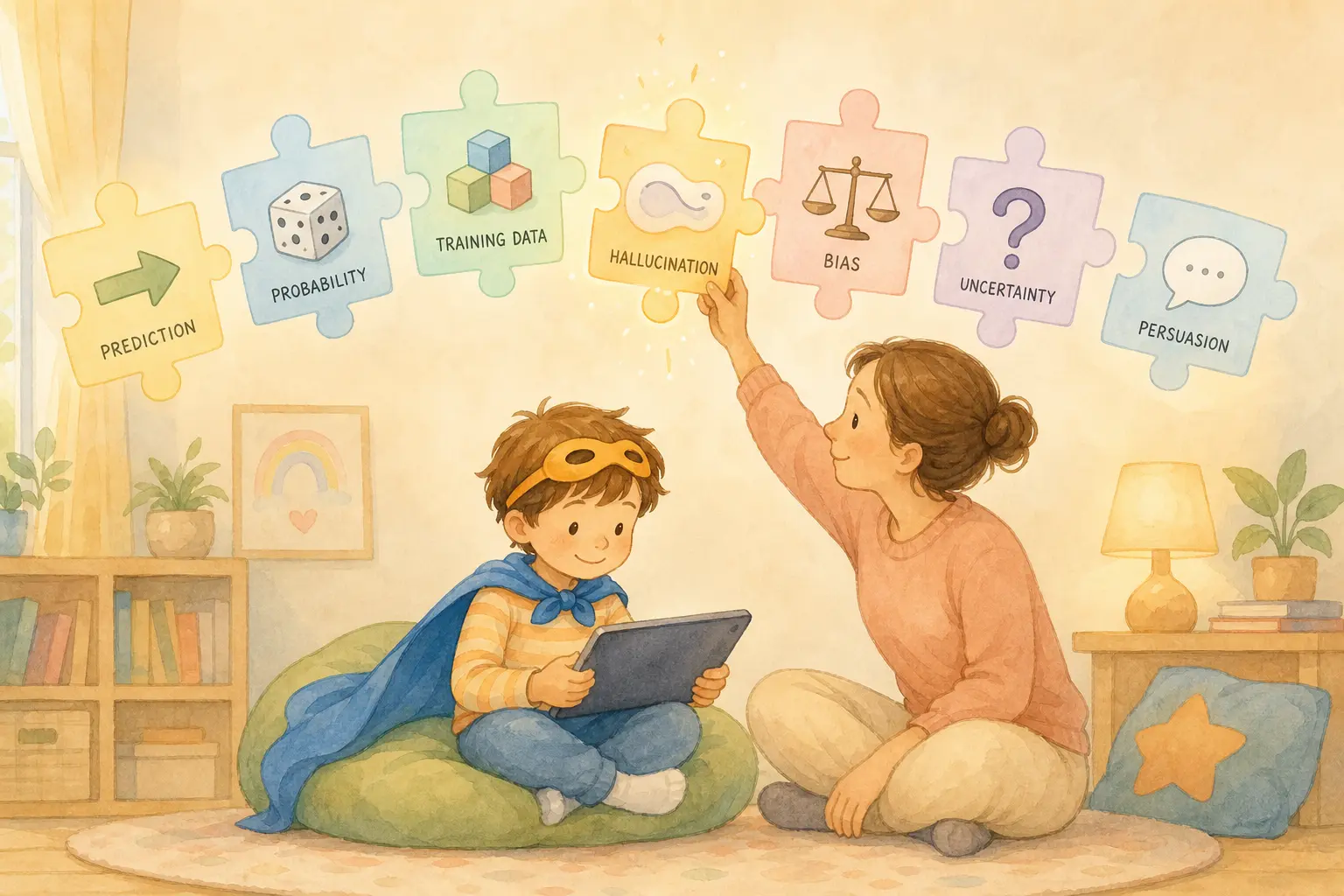
A child can be brilliant at using AI and still have almost no idea how it works. That is the Competence–Understanding Gap. Competence is “I can make it do things.” Understanding is “I know what it is actually doing.” Without understanding seven core ideas, competence becomes dangerous.

The Identity Fortress: Three Family Rituals AI Can Never Replace

Family rituals

AI can be a tutor, a playmate, an answer machine. It cannot give your child a sense of who they are and where they belong. That comes from three irreplaceable family rituals that build an identity fortress.

Secret Link