
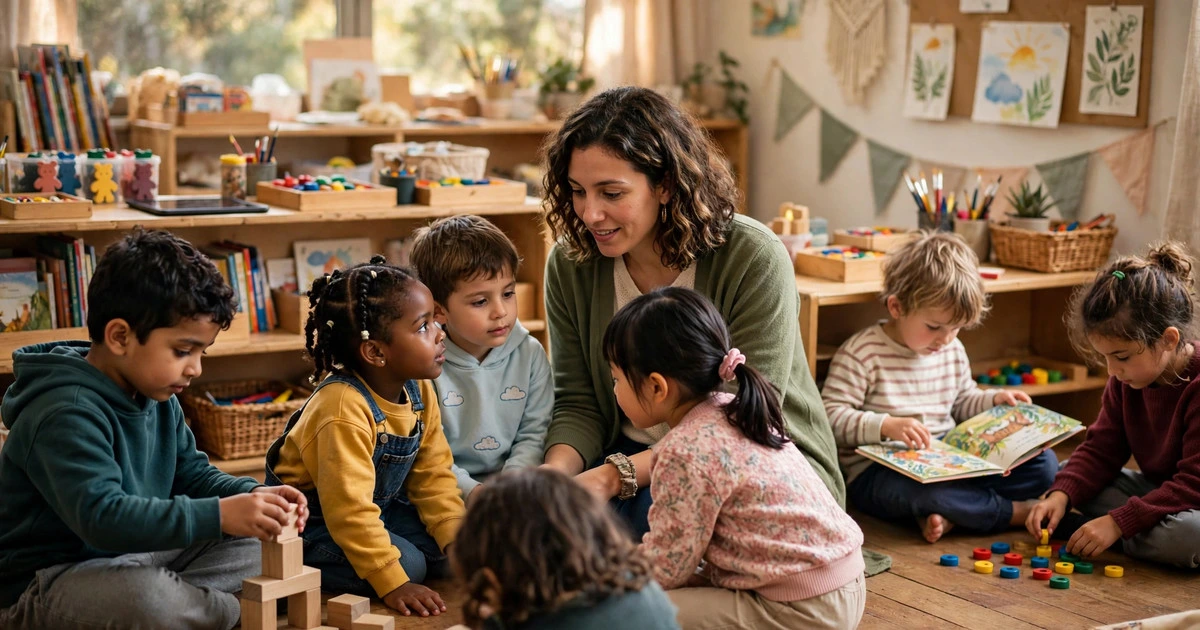
Foundational learning is often described as the acquisition of basic literacy and numeracy. For children aged 3–8, however, it is much broader: it includes oral language, vocabulary, attention, self-regulation, early number sense, curiosity, social relationships, and the ability to make sense of the world. These capabilities do not emerge from a curriculum document alone. They develop through responsive teachers, meaningful language, supportive homes, guided play, and everyday experiences that help children connect learning to their lives.
This blog argues that foundational learning becomes possible when adults create rich opportunities for children to talk, play, explore, and receive feedback. It also argues that AI pre-literacy should be understood as part of this broader foundation—not as a separate technology subject added to an already crowded early-years curriculum.
Teachers make foundational learning possible
Teachers are central to young children’s learning because they shape the quality of everyday interactions in classrooms. A meta-analysis of 24 studies involving 67,919 children found that teacher-child interactions, measured through the Classroom Assessment Scoring System, were moderately associated with children’s language, mathematics, and self-regulation outcomes, and were also linked to literacy and social development (Pakarinen et al., 2023). This suggests that the way teachers talk with children, ask questions, provide feedback, and organise learning activities matters across multiple domains.
The cumulative nature of these interactions is especially important. Cash et al. (2019) found that children who experienced consistently high-quality instructional support in prekindergarten and kindergarten showed greater language and literacy gains than children who experienced consistently low-quality support. The benefits were stronger when high-quality interactions continued across two years, indicating that isolated improvements are less powerful than sustained, high-quality teaching.
For young children, instructional support does not mean formal drilling. It means teachers who extend children’s ideas, introduce new vocabulary, model reasoning, ask open-ended questions, and help children persist through difficulty. It also means teachers who understand child development and can adapt their practice to children’s different languages, abilities, and starting points.
Language is the foundation of learning
Language is not simply one subject among many; it is the medium through which children learn nearly everything else. Children use language to describe experiences, ask questions, negotiate with peers, follow instructions, express emotions, and develop early concepts about number, time, cause, and possibility. A classroom’s literacy environment includes both physical resources, such as books and writing materials, and interactive dimensions, such as teacher-child and child-child conversations (Lachapelle et al., 2024).
However, materials alone do not guarantee engagement. Lachapelle et al. (2024) found that although classroom literacy environments were generally of basic quality, children’s engagement remained low in teacher, peer, and conflict interactions. Their findings also showed that socioeconomic status, child age, and group size were associated with engagement. This highlights an important lesson: books, posters, and printed labels are useful, but children need adults who use them purposefully through conversation, shared reading, storytelling, and responsive questioning.
In multilingual settings, including Pakistan, this point is particularly significant. Children may enter school speaking a home language different from the language of instruction. If their home language is treated as an obstacle rather than a resource, they may be asked to learn content, vocabulary, and a new language simultaneously. Foundational learning becomes more equitable when teachers value children’s existing language, use it to build understanding, and gradually develop proficiency in the language of schooling.
Homes and communities shape early learning
Learning does not begin when children enter preschool or Grade 1. It begins in homes and communities, where children hear language, observe adults, play, ask questions, and encounter print, numbers, stories, and digital technologies. The home literacy environment includes material resources, interpersonal interactions, shared book reading, literacy games, parent-child conversations, and adults’ beliefs and expectations about literacy (Evans et al., 2000; Sénéchal & LeFevre, 2002; Krijnen et al., 2020).
Recent research shows that different home activities contribute differently to early literacy. A study of more than 1,000 preschoolers found that print-related activities were the strongest predictor of early literacy skills, while shared book reading was significantly related to literacy skills among children with typical development (Radville et al., 2025). This does not mean shared reading is unimportant; rather, it suggests that families benefit from a range of activities, including talking, storytelling, drawing, labelling objects, playing with letters and sounds, and reading together.
Policy and practice should therefore avoid placing unrealistic burdens on parents. Many caregivers face poverty, long working hours, limited literacy, disability, or lack of access to books. The goal should be to strengthen families’ existing practices and provide accessible support, not to assume that every household can reproduce a middle-class, print-rich learning environment. Community libraries, mobile book services, radio and television storytelling, caregiver groups, and simple home-learning activities can extend learning opportunities beyond school.
Play is serious learning
Play is sometimes treated as a break from “real” learning. In early childhood, however, play is one of the most powerful ways children develop language, imagination, problem-solving, social skills, and early academic concepts. A scoping review of 51 studies on play-based learning found substantial theoretical and empirical research on its role in early childhood education, particularly for pre-primary-aged children (Mohammed et al., 2026).
Play becomes especially powerful when teachers participate intentionally. Research with early childhood educators shows that literacy and numeracy learning can be made visible in child-initiated play when educators design environments, observe children, join play, introduce vocabulary, and pose challenges (McLean et al., 2025). In pretend play, children may act as shopkeepers, doctors, storytellers, builders, or explorers; in doing so, they practise communication, counting, sorting, measuring, narrative-building, and collaborative problem-solving.
Culturally relevant play also matters. A study of preschool learners in Zambia found that indigenous games supported numeracy development and argued that culturally relevant play can serve as a transformative approach to early numeracy instruction (Mwinsa et al., 2026). For Pakistan, this suggests that local games, stories, songs, markets, festivals, crafts, and everyday routines can become meaningful resources for early literacy and numeracy rather than being replaced by standardised, decontextualised materials.
AI pre-literacy begins with relationships
As artificial intelligence becomes more visible in children’s lives, early education must help children understand that some technologies can respond, recommend, generate, and sometimes make mistakes. This is the starting point of AI pre-literacy: not coding, not complex technical vocabulary, and not unsupervised screen use, but the development of curiosity, caution, and critical awareness.
Research suggests that young children can engage with basic AI concepts when learning is embodied, playful, and guided by teachers. In a study of five-year-olds in Hong Kong, children learned about AI through interactions with intelligent agents in an embodied learning context, with teachers guiding the activities (Yang et al., 2024). Another intervention study found that children with an average age of four were capable of learning basic AI concepts and expressing AI-related creativity through drawing, storytelling, and imaginative design activities (Su & Yang, 2024).
These findings should not be interpreted as a call to place young children in front of AI tools. Teachers themselves emphasise that technology should complement, not replace, human interaction and should prioritise social interaction, emotional engagement, and active learning (Su & Yang, 2026). In low-resource or low-connectivity settings, AI pre-literacy can begin without devices: children can discuss voice assistants, recommendation systems, talking toys, or images generated by AI; they can ask who made the technology, what data it might use, and whether its answers are always correct.
What foundational learning requires
Making foundational learning work for young children requires coordinated action across classrooms, homes, and communities:
- Invest in teachers’ pedagogical knowledge. Teachers need sustained support in early language and literacy, numeracy, child development, play-based pedagogy, formative assessment, and inclusive practice.
- Create language-rich environments. Classrooms should include meaningful talk, books, storytelling, writing opportunities, and space for children’s home languages.
- Support families without blaming them. Provide practical, culturally relevant ways for caregivers to talk, read, play, and learn with children.
- Use guided play intentionally. Teachers should connect play to literacy, numeracy, problem-solving, and children’s interests without turning play into rigid instruction.
- Introduce AI pre-literacy relationally. Help children notice, question, and interpret AI technologies through conversation, stories, role-play, and guided exploration.
- Protect childhood. Foundational learning should strengthen children’s agency, well-being, and curiosity—not reduce early years to testing and narrow skill acquisition.
Conclusion
Foundational learning is built through relationships, language, play, and everyday experiences. Teachers matter because they create the interactions through which children learn; families matter because learning begins long before school; and play matters because it allows children to explore ideas in meaningful and culturally grounded ways. AI pre-literacy belongs within this foundation when it helps children become curious, cautious, and thoughtful participants in an AI-shaped world.
Continuity statement: The next blog, “Standardization and Equity in the Early Years: Can One Foundational Learning Agenda Serve All Children?”, will examine which elements of early learning should be common for all children and which must respond to different languages, families, disabilities, and access to resources.
About the Authors
Authors and education researchers working on children’s development, education, and the implications of artificial intelligence for the emerging AI-driven society.
References
Cash, A. H., Ansari, A., Grimm, K. J., & Pianta, R. C. (2019). Power of two: The impact of 2 years of high quality teacher-child interactions. Early Education and Development, 30(1), 60–81. https://doi.org/10.1080/10409289.2018.1538616
Evans, M. A., Shaw, D., & Bell, M. (2000). Home literacy activities and their influence on early literacy skills. Canadian Journal of Experimental Psychology, 54(2), 65–75. https://doi.org/10.1037/h0087330
Krijnen, E., van Steensel, R., & Meeuwisse, M. (2020). Parental beliefs and home literacy practices: Relationships with children’s language and literacy development. In Handbook of home language maintenance and development (pp. 243–260). Multilingual Matters.
Lachapelle, J., Charron, A., & Bigras, N. (2024). Literacy environment in early childhood classrooms: Associations with children’s engagement. Journal of Education and Learning, 13(6), 46–60. https://doi.org/10.5539/jel.v13n6p46
McLean, C., Cummings, R., LeBlanc, L. A., Briscombe, A., Mohamed, D., & McIsaac, J.-L. D. (2025). Making numeracy and literacy learning visible in play-based publicly funded programs. Journal of Early Childhood Literacy, 25(2), 307–332. https://doi.org/10.1177/14687984251351202
Mohammed, A. H., Nigussie, B., Schellens, T., et al. (2026). Play-based learning in early childhood education: A scoping review. Early Childhood Education Journal, 54, 3929–3975. https://doi.org/10.1007/s10643-026-02127-6
Mwinsa, G. M., Matafwali, B., & Chewe, M. M. (2026). Numeracy skills development through indigenous games in pre-school learners: A teacher perspective. International Journal of Child Care and Education Policy, 20, Article 19. https://doi.org/10.1186/s40723-026-00187-0
Pakarinen, E., Lerkkanen, M.-K., & Poikkeus, A.-M. (2023). A meta-analysis of teacher-child interaction and early child outcomes from the perspective of CLASS. Early Child Development and Care, 194(2), 153–174. https://doi.org/10.1080/03004430.2023.2273788
Radville, K. A., Murphy, K. A., Justice, L. M., et al. (2025). Measurement invariance of the home literacy environment for children with and without speech and/or language impairment. Journal of Research in Reading. Advance online publication. https://doi.org/10.1111/1467-9817.70010
Sénéchal, M., & LeFevre, J.-A. (2002). Parental involvement in the development of children’s reading skill: A five-year longitudinal study. Child Development, 73(2), 445–460. https://doi.org/10.1111/1467-8624.00417
Su, J., & Yang, W. (2024). Artificial intelligence (AI) literacy in early childhood education: An intervention study in Hong Kong. Interactive Learning Environments, 32(9), 5494–5508. https://doi.org/10.1080/10494820.2023.2217864
Su, J., & Yang, W. (2026). Artificial intelligence in early childhood education: Teachers’ perceptions, ethical concerns, and professional development needs. European Early Childhood Education Research Journal. Advance online publication. https://doi.org/10.1080/1350293X.2025.2610619
Yang, W., Hu, X., Yeter, I. H., Su, J., Yang, Y., & Lee, J. C.-K. (2024). Artificial intelligence education for young children: A case study of technology-enhanced embodied learning. Journal of Computer Assisted Learning, 40(2), 465–477. https://doi.org/10.1111/jcal.12892