
Last week I watched a 10-year-old boy.
He opened an AI app, typed a perfect prompt: “Write my science report on rain in 100 words for class 5 in simple English.”
In 5 seconds, he had a perfect report. He was competent. Very competent.
I asked him, “How did it write this?”
He said, “It knows.”
I asked, “What does it know? Where did it learn about rain?”
He said, “From the internet.”
I asked, “Can it be unsure? Can it be biased? Can it try to persuade you?”
He looked at me blankly. “It just answers, Professor.”
That boy is not alone. He represents millions of children today. They are highly competent users of AI. They know how to prompt, how to regenerate, how to make it sound like them. But they have almost no conceptual understanding of what AI actually is. We call this the Competence–Understanding Gap. It is one of the most important ideas we want to share with you, because it will define your child’s safety in the next 10 years.
Competence is: “I can make it do things.”
Understanding is: “I know what it is doing, what it is not doing, and what it cannot do.”
Today, schools and apps are racing to build competence. Almost no one is building understanding. And without understanding, competence is not power. It is vulnerability.
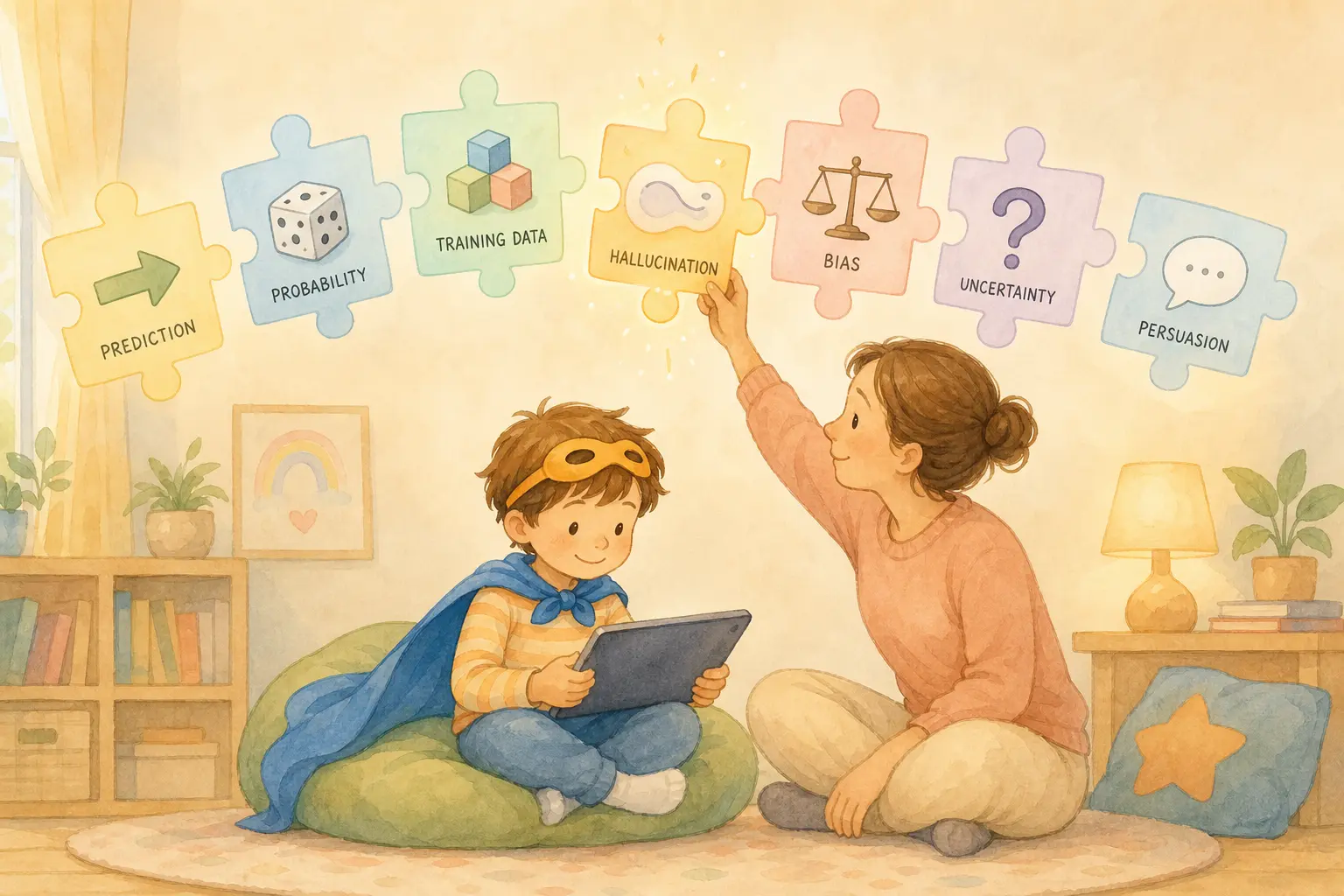
Let me explain the seven ideas every child must understand before we call them AI-literate. You don’t need to be a computer scientist to teach these. You can teach them at your kitchen table.
1. Prediction, Not Knowledge — AI Does Not Know, It Predicts
Children think AI knows answers the way a teacher knows. It does not.
AI is a prediction machine. Given your words, it predicts what word is most likely to come next, based on patterns it has seen (Goodfellow et al., 2016).
It does not open a book of truth. It completes a sentence.
Home explanation: Play “Finish My Sentence.” Say: “In the morning, I drink…” Your child will say “chai” because that is the most predictable next word in your family. Ask: Did you know I would drink chai, or did you predict it because it usually happens? AI does the same, but with billions of sentences.
Key takeaway: AI doesn’t know. It predicts what sounds most likely.
2. Probability, Not Certainty — AI Speaks Confidently Even When Unsure
AI speaks in a confident voice. But inside, it is calculating probabilities — 70% this word, 30% that word (Bhatt et al., 2021).
It does not have a feeling of being sure or unsure like we do. It just picks the highest probability.
This is why a child says, “But it said it so confidently, so it must be true.”
Home explanation: Put 7 white marbles and 3 black marbles in a bag. Ask child to pick without looking. Most times they will pick white. Ask: Does picking white mean there are no black marbles? No. It just means white was more probable. AI also picks the more probable word, but the less probable could still be true.
Key takeaway: Confident voice does not mean certain truth.
Training Data — AI Learned From What Humans Left Behind
AI did not learn from the world. It learned from data about the world — what people wrote, photographed, and uploaded (Jo & Gebru, 2020).
If that data had more stories about certain people, jobs, or countries, AI will think those are more normal or more important.
If that data had mistakes, AI will learn mistakes.
Home explanation: Show two photo albums. One has 20 pictures of cats, 2 of dogs. Ask: If someone only saw this album, what would they think the world has more of? Cats. Is that true? No. AI also thinks the world is like its album. We call its album training data.
Key takeaway: AI knows only what it was fed. And we humans fed it an uneven world.
4. Hallucination — AI Can Make Up Things That Sound Perfectly Real
Because AI predicts, not knows, it can predict a beautiful, completely false answer — with a fake citation, a fake date, a fake fact (Ji et al., 2023).
We call this hallucination. Not lying — AI does not intend to deceive. It is just predicting the next plausible word, even if no real fact supports it.
For a child, this is dangerous, because false answers look exactly like true answers.
Home explanation: Play “Plausible Story.” Ask child to tell a story about a dinosaur going to your school today. It will sound real, but it is invented. AI does the same — it can invent a book that does not exist and tell you the page number.
Key takeaway: If it sounds perfect, check if it is real.
5. Bias — AI Can Be Unfair Without Meaning to Be
Because its training data is uneven, AI learns uneven associations. It may associate nurses more with women, pilots more with men, or English speakers more with certain countries (Mehrabi et al., 2021).
A child using AI for career ideas or story characters may slowly learn a narrow view of who can be what.
Home explanation: Ask AI: “Show me a picture of a doctor.” Then “Show me a picture of a kind doctor.” Ask child: Who did it show? Why? Did it ever show someone like your khala? Why not? This is bias — not hate, but narrowness from narrow data.
Key takeaway: AI can repeat the unfairness of the past unless we notice it.
6. Uncertainty — AI Rarely Says “I Don’t Know”
A wise teacher says, “I don’t know. Let’s find out.”
AI is trained to answer. It is rarely rewarded for saying “I don’t know” (Bhatt et al., 2021). So it answers, even when its internal probability is low.
Children need to learn that not answering is sometimes smarter than answering.
Home explanation: Ask child a hard question you know AI will answer: “What did my great-grandmother eat on her 5th birthday?” AI will invent something. Ask child: Should a good helper say “I don’t know, there is no record” or make something up to please you? Which is more honest?
Key takeaway: A good thinker knows when to say “I don’t know.” AI often doesn’t.
7. Algorithmic Persuasion — AI Is Designed to Keep You Asking
AI is not just a tool. It is a tool designed to keep you using it. Its responses are optimized to be pleasing, agreeable, and engaging (Susser et al., 2019). It learns to agree with you to keep you happy — a pattern now called sycophancy.
A child who hears “Great question!” and “You are so smart!” every time will start to depend on that praise to feel smart.
Home explanation: Ask child: Does your favourite shop give you a toffee so you come back? AI also gives you sweet words so you come back. Is the toffee because you are good, or because the shop wants you to return? Help them see persuasion.
Key takeaway: AI is not just answering you. It is also trying to keep you.
What Peer-Reviewed Research Shows
Foundational AI literacy research shows children initially conceptualize AI as an all-knowing database rather than a probabilistic prediction system trained on human data, leading to overtrust (Long & Magerko, 2020). Studies on calibration and uncertainty demonstrate that language models are poorly calibrated — they express high confidence even when incorrect (Bhatt et al., 2021). Research on hallucination, dataset bias, and algorithmic persuasion confirms these are not edge cases but core properties of how large models are built and optimized (Ji et al., 2023; Mehrabi et al., 2021; Susser et al., 2019).
What Parents Can Do for Understanding, Not Just Competence
- Protect the Prediction Game — Daily 2-minute “Finish My Sentence” to teach prediction vs knowledge.
- Protect the Data Album — Show your child what data is. “What album did AI see? What album did it NOT see?”
- Protect the Two-Source Check — For every AI answer for homework, ask: How will we check if this is real? One check must be non-AI.
- Protect the Bias Hunt — Once a week, ask AI for pictures or stories and ask: Who is missing? Who is always shown?
- Protect the “I Don’t Know” — Praise your child when they say “I don’t know, I need to check.” Model it yourself.
A Hopeful Conclusion
I am not saying your child should not be competent. Competence is wonderful.
I am saying competence without understanding is like giving a child a fast car without teaching them what fuel is, what brakes are, or where the road ends.
When your child understands these seven ideas — prediction, probability, training data, hallucination, bias, uncertainty, and algorithmic persuasion — something beautiful happens.
They stop being an Oracle Child who says “AI said it, therefore it must be true.”
They become a Questioning Child who says “AI predicted this, based on this data, with this probability, and it may be biased or unsure, so let me check.”
That child is not behind AI. That child is ahead of AI. Because that child has what AI will never have: judgment.
This understanding is not hard to build. It is built in 5-minute conversations at dinner, in marble bags, in photo albums.
And this is exactly why we are writing our upcoming book — to give you not just warnings, but daily 5-minute rituals to turn competent users into understanding thinkers. Your child can love AI and still question it. That is the future we want.
We are with you.
What About You?
Has your child ever believed an AI answer that turned out to be invented? How did you explain hallucination to them? Share below — we are learning together.
About the Authors
Dr. Shaheen Pasha is a Professor of Special Education with over 35 years of teaching, research, and academic leadership experience. She served as Professor and Chairperson of the Department of Special Education at the University of Education, Lahore. She earned her Ph.D. in Special Education from the University of Southampton, UK. She has published more than 35 research papers and co-authored two books. Her expertise lies in child development, cognitive growth, and special education.
Dr. M. Anwar-ur-Rehman Pasha (widely recognized in academic circles as Dr. M. A. Pasha) is a Professor of Computer Science with over 35 years of post-graduate teaching, research, and educational management experience. He earned his Ph.D. in Computer Science from the University of Southampton, UK in 1996. His research focuses on Artificial Intelligence, Human-Computer Interaction, and Computational Thinking. He has published two books and over 30 research articles.
Together, they bring 70 years of combined wisdom to help parents raise capable, thoughtful children in the age of AI.
References
Bhatt, U., et al. (2021). Uncertainty as a form of transparency. NeurIPS.
Goodfellow, I., et al. (2016). Deep learning. MIT Press.
Ji, Z., et al. (2023). Survey of hallucination in natural language generation. ACM Computing Surveys.
Jo, E. S., & Gebru, T. (2020). Lessons from archives: Strategies for collecting sociocultural data in machine learning. FAccT.
Long, D., & Magerko, B. (2020). What is AI literacy? Competencies and design considerations. CHI.
Mehrabi, N., et al. (2021). A survey on bias and fairness in machine learning. ACM Computing Surveys.
Susser, D., Roessler, B., & Nissenbaum, H. (2019). Technology, autonomy, and manipulation. Internet Policy Review.