
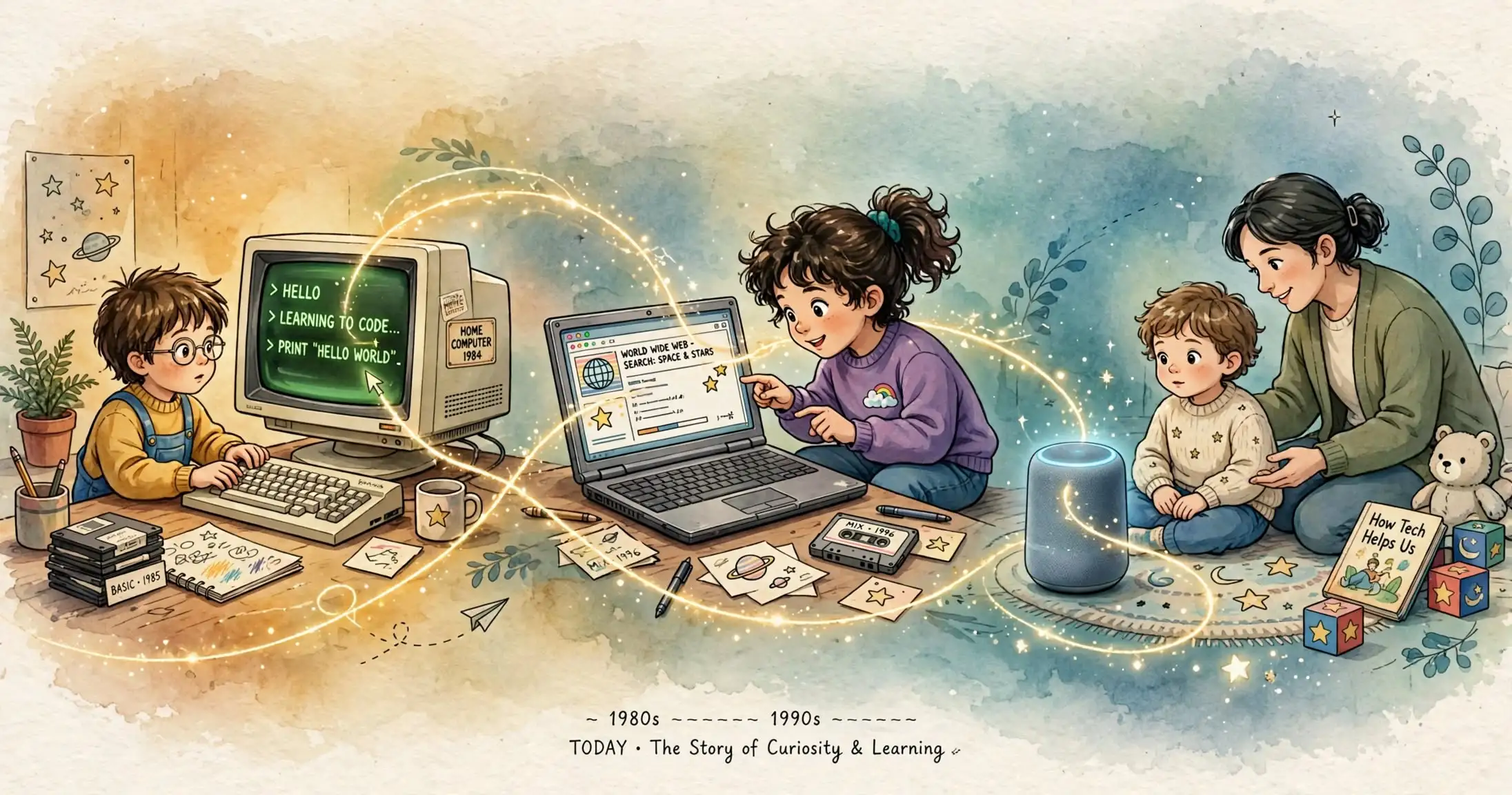
A mother recently told me about her five-year-old son. The boy had learned to say “Hey Google, what’s the weather?” before he could read a single word. One morning, he asked the device a question. The answer was wrong.
He asked again. Wrong again.
He turned to his mother, confused. “Why doesn’t it know?”
His mother paused. Her son had never been taught that a machine could be mistaken. He had never been taught what the machine actually was. He was simply learning to trust it.
That moment captures something important. We have spent four decades teaching children to use technology. We have not spent enough time teaching them to understand it. And the youngest children—those aged two to seven—are the ones most left behind.
In our previous blogs, we have explored AI literacy as prompting, creating, and questioning. We have examined why AI literacy begins at age eight, while AI experience begins at age two. Now we must look at the longer story: how we got here, and who we left behind along the way.
The Journey: From Computer Literacy to AI Literacy
The term “computer literacy” became popular in the 1980s as a catchphrase for a new type of understanding (Hess, 1994). It was a recognition that knowledge of computers had become as important to a child’s education as reading and writing had been in the past. Beginning in 1980, school districts began developing courses on computer literacy, generally at the junior and senior high levels (ERIC, 1983). Most were electives. Most were for older students.
The goal was modest: teach children how computers worked, how to use them, and how they might affect society.
By the late 1990s, the conversation shifted. Paul Gilster introduced the term “digital literacy” in his 1997 book of the same name, defining it as the ability to understand, use, evaluate, and integrate digitized information (Gilster, 1997). The focus moved from operating hardware to navigating information.
Now we face a third shift. AI literacy is becoming the new baseline. As one observer notes: “Just as computer literacy expanded the capabilities of an entire generation, AI literacy is becoming the new baseline for individual and organisational empowerment” (UK Tech News, 2026). Computer literacy once prepared us for the digital age. AI literacy will prepare us for the intelligence age.
But here is the problem. Each of these transitions followed the same pattern. The focus was on older children. The youngest learners were left to catch up later.
Key takeaway: We have spent forty years teaching children to use technology. We have consistently started too late—and the youngest children have consistently been left behind.
The Gap Nobody Is Talking About
AI literacy in early childhood education—ages three to eight—remains an underdeveloped research area compared to the rapidly expanding body of work for adults and older students (Yadollahi et al., 2026). Significant challenges remain, including limited AI knowledge among caregivers and educators, a lack of validated age-appropriate curricula, and ongoing concerns about overuse, privacy, and misunderstandings of AI capabilities.
A 2026 systematic review of early childhood AI literacy found that the field faces a critical challenge: a lack of scientifically grounded frameworks for young children. The analysis uncovered what researchers call a “systemic Tool-Driven bias,” where educational goals are often defined by the capabilities of commercial hardware rather than by developmental needs (Framing Early Childhood AI Literacy, 2026).
In other words: we are designing AI education around what the technology can do, not around how young children actually learn.
Meanwhile, children are already interacting with AI. A 2025 report from The 74 Million notes that children as young as three and four are already using AI-enabled services—voice assistants, recommendation engines, adaptive learning apps—yet they lack understanding of the underlying technology. “Without early education on how AI works and where its limits lie,” the report warns, “the youngest generation is at risk of growing up to trust machines without question” (The 74 Million, 2025).
Key takeaway: Young children are already AI users. They are not yet AI literate. And the gap is growing.
What We Teach Older Children—And Why It Isn’t Enough
The frameworks we have built are valuable. UNESCO’s AI Competency Framework for Students outlines twelve competencies across four dimensions: a human-centred mindset, ethics of AI, AI techniques and applications, and AI system design (UNESCO, 2025). The OECD and European Commission’s AI Literacy Framework organizes literacy into four domains—engage, create with, manage, and shape AI—with learner expectations spanning primary and secondary education (OECD & European Commission, 2026).
These frameworks are thoughtful, research-informed, and necessary. But they share a common assumption: that the learner is already capable of abstract reasoning, reading, and formal instruction. They assume a child who is already eight.
The child aged two, three, or five is not yet in the room.
A 2026 workshop paper on community-centered AI literacy observes that “AI literacy in early childhood education (ages 3-8) remains an underdeveloped research area” and that “significant challenges remain, including limited AI knowledge among caregivers and educators, a lack of validated age-appropriate curricula” (Yadollahi et al., 2026).
The child we left behind is the one who cannot yet read the manual we have written.
Key takeaway: Our frameworks are built for children who can already read, reason, and reflect. The youngest learners need something different—and they need it now.
The AI Divide: A New Fault Line
There is another dimension to this gap. It is not only about age. It is about equity.
A 2025 analysis identifies three interconnected issues: an “AI divide” in access and use of AI for learning between socioeconomically advantaged and disadvantaged children, accessibility and opportunity gaps in AI literacy acquisition between these groups, and an ethical gap in AI use by children (Springer, 2025).
UNICEF’s 2026 report on the AI divide warns that “the dangers to social justice are greatest where AI shaped decisions affect people who rely most on public and health services and who are more likely to be digitally excluded due to age, poverty, disability or distrust of digital systems” (UNICEF, 2026).
The children left behind are not only the youngest. They are also the most vulnerable.
Key takeaway: The AI literacy gap is not just a developmental gap. It is an equity gap. And it is widening.
What Parents Can Do Right Now
You do not need to wait for a curriculum. You do not need to be an expert. You need to start where your child is.
1. Acknowledge that AI literacy begins before reading.
You can talk to a three-year-old about AI. You can ask: “Is Alexa a person? How does she know what to say?” These early conversations build the foundation for everything that follows.
2. Teach the three core ideas.
Research on early childhood AI literacy identifies three concepts children as young as four can understand: AI obeys instructions. AI is not sentient. AI supports people (Lee, 2026). Repeat these ideas often, in simple language.
3. Be a guide, not an expert.
UNICEF advises that parents can begin talking about AI when children are quite young, because many kids already encounter AI in their everyday lives. It can be helpful to move away from the idea that parents must always act as experts or supervisors (UNICEF, 2026).
4. Use play, not lectures.
The “Play with AI” curriculum for pre-K and kindergarten introduces foundational AI concepts through unplugged play—children composing and testing “how-to” algorithms, tangible coding with floor robots, and guided dialogue with a social AI robot (Lee, 2026). You can do versions of this at home: simple games, picture cards, and conversations.
5. Protect play and human connection.
AI pre-literacy matters. But it is not a substitute for human relationships. Children need time to play, explore, and connect with real people—experiences that teach them what it means to be human.
Key takeaway: You do not need a curriculum. You just need to start the conversation—early, often, and with warmth.
A Hopeful Conclusion
Forty years ago, we taught children to use computers. Twenty-five years ago, we taught them to navigate digital information. Today, we must teach them to understand artificial intelligence.
But we must not repeat the same mistake. We must not wait until they are eight. We must not leave the youngest children behind.
The child we left behind is not a lost cause. They are simply waiting for us to begin. They are waiting for the words that will help them understand the world they are already living in.
The distinction to teach:
“The machine can answer your questions. But it is not a person. It does not know everything. And the most important questions are the ones you ask yourself—and the ones you ask the people who love you.”
What About You?
Has your young child ever asked you a question about a smart device that you struggled to answer? How did you respond?
Share your experience in the comments below. We read every single one.
About the Authors
Dr. Shaheen Pasha is a Professor of Special Education with over 35 years of teaching, research, and academic leadership experience. She served as Professor and Chairperson of the Department of Special Education at the University of Education, Lahore. She earned her Ph.D. in Special Education from the University of Southampton, UK. She has published more than 35 research papers and co-authored two books.
Dr. M. Anwar-ur-Rehman Pasha (widely recognized in academic circles as Dr. M. A. Pasha) is a Professor of Computer Science with over 35 years of post-graduate teaching, research, and educational management experience. He earned his Ph.D. in Computer Science from the University of Southampton, UK in 1996. His research focuses on Artificial Intelligence, Human-Computer Interaction, and Computational Thinking. He has published two books and over 30 research articles.
Together, they bring 70 years of combined wisdom to help parents raise capable, thoughtful children in the age of AI.
References
Framing early childhood AI literacy: What did the literature review tell us? (2026). AI, Brain and Child. https://link.springer.com/article/10.1007/s44436-026-00028-4
Gilster, P. (1997). Digital literacy. Wiley.
Hess, C. A. (1994). Computer literacy: An evolving concept. School Science and Mathematics, 94(4), 208-214. https://onlinelibrary.wiley.com/doi/abs/10.1111/j.1949-8594.1994.tb15656.x
Lee, J. (2026). Play with AI (PL-AI): A play-centered, design-based curriculum for AI literacy in pre-K and kindergarten. Computers and Education: Artificial Intelligence. https://www.sciencedirect.com/science/article/pii/S2666920X26000317
OECD & European Commission. (2026). Empowering learners for the age of AI: An AI literacy framework for primary and secondary education. OECD Publishing. https://stage.ailiteracyframework.org/blog/empowering-learners-for-the-age-of-ai-literacy-framework/
Springer. (2025). Leveraging AI to enhance children’s learning: Anchoring policy and practice in equity, AI literacy, and ethics. Educational Technology Research and Development. https://link.springer.com/article/10.1007/s11423-025-10467-0
The 74 Million. (2025, July 24). Why AI literacy instruction needs to start before kindergarten. https://www.the74million.org/zero2eight/why-ai-literacy-instruction-needs-to-start-before-kindergarten/
UK Tech News. (2026, February 12). Computer literacy has evolved: It’s now AI literacy. https://uktechnews.co.uk/2026/02/12/computer-literacy-has-evolved-its-now-ai-literacy/
UNESCO. (2025). AI competency framework for students. UNESCO Publishing. https://www.unesco.org/es/articles/marco-de-competencias-para-estudiantes-en-materia-de-ia
UNICEF. (2026, January 29). AI divide: A new fault line we cannot ignore. https://www.unicef.org/globalinsight/stories/ai-divide-new-fault-line-we-cannot-ignore
Yadollahi, E., Bai, Z., Chandra, S., Dangol, A., Neto, I., & Suneesh, S. (2026). Growing up with AI: Approaches to community-centered AI literacy. Proceedings of the 25th Annual ACM Interaction Design and Children Conference. https://dl.acm.org/doi/full/10.1145/3773077.3816198