
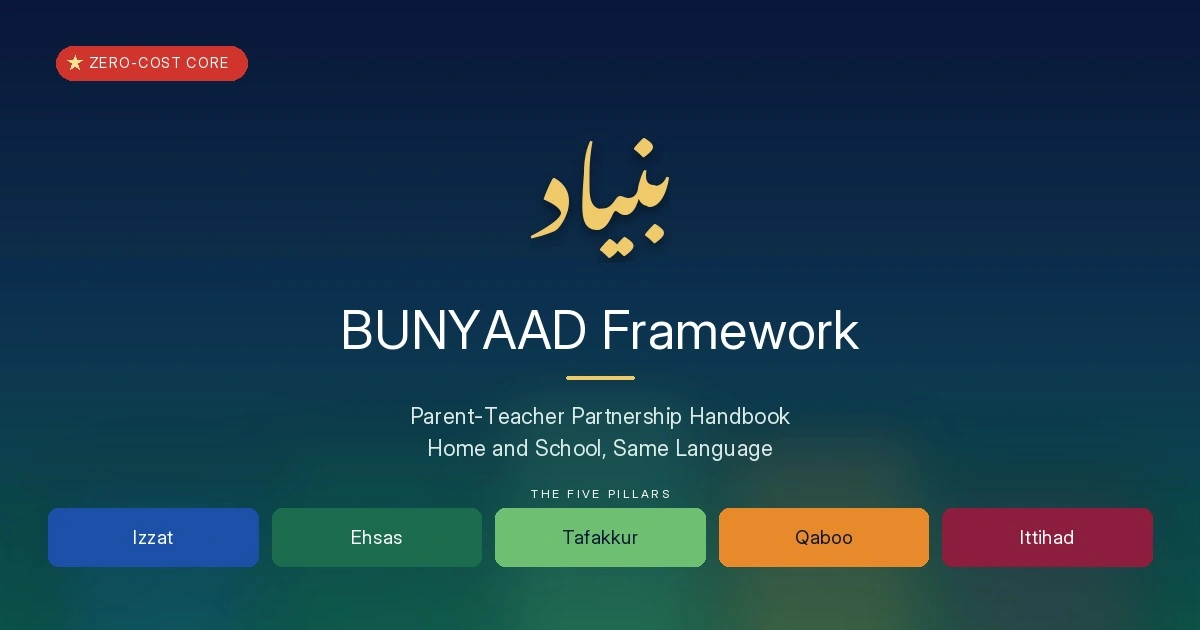
We are thrilled to announce the launch of the BUNYAAD Framework—a zero-cost, culturally rooted, and evidence-based framework designed to transform education in South Asia.
After months of development, testing, and refinement in classrooms across Pakistan—from the bustling schools of Lahore to the remote villages of Sindh and Punjab—BUNYAAD is now available to teachers, parents, schools, and communities everywhere.
BUNYAAD means “foundation” in Urdu. And that is exactly what it builds—the foundation for learning and well-being in every classroom and every home.
📖 Table of Contents
- Why BUNYAAD Exists
- The Five Pillars of BUNYAAD
- What Makes BUNYAAD Different
- Available Resources
- Who Is BUNYAAD For?
- A Personal Message from the Author
- Join the BUNYAAD Community
- Share This Post
🔴 Why BUNYAAD Exists
The Problem: The Silent South Asian Classroom
In classrooms across South Asia—from the rural villages of Pakistan to the crowded government schools of India, from the madrassahs of Bangladesh to the remote mountain schools of Nepal and Sri Lanka—children sit silently in the back rows.
They do not ask questions.
They do not raise their hands.
They have learned that speaking leads to shame, mistakes lead to punishment, and their voice does not matter.
This is not a small problem. This is the foundation of all learning.
If a child cannot ask a question, they cannot learn.
If they cannot speak, they cannot participate.
If they are afraid of being wrong, they will never take intellectual risks.
And without intellectual risk, there is no growth. No critical thinking. No innovation. No future.
The Solution: BUNYAAD
BUNYAAD was not imported from the West. It was born in Lahore and shaped by the voices of South Asian teachers, parents, and children.
It is a culturally rooted, zero-cost framework that directly addresses the root causes of silence in South Asian classrooms. It gives parents and teachers the same language, routines, and values—building a foundation where every child feels safe, heard, respected, and understood.
💚 The Five Pillars of BUNYAAD
At the heart of the BUNYAAD Framework are five pillars—each directly addressing a specific aspect of the “silent classroom” problem.
🔵 Pillar 1: Izzat (Respect, Dignity, Psychological Safety)
The Problem: Children are afraid of being wrong. They have been shamed, mocked, or compared. “Galat!” is the most common word they hear.
The Remedy:
- “Thank you for trying” replaces “Galat!”—Mistakes become information, not failure.
- Equity sticks ensure back-row children (especially girls) get called. Every voice matters.
- No public shaming, no sarcasm, no labeling. The classroom becomes a safe space.
- Mistakes are treated as information—”What made you think that?”—not as something to punish.
The Transformation:
A child who was afraid to speak now knows, “If I am wrong, I will not be mocked. I will be thanked for trying.”
💚 Pillar 2: Ehsas (Empathy, Compassion, Perspective-Taking—INDEPENDENT PILLAR)
The Problem: When children are silent, teachers assume they are “weak” or “slow.” They are pitied, not understood. “Bechara” / “Bichara” lowers expectations and keeps them silent.
The Remedy:
- “What I hear you saying is…” — The teacher listens. The child is heard.
- Feeling check-in (30 seconds)—”How are you feeling today?”—validates the child’s internal state.
- Perspective-taking—”How do you think she felt? “Why?” builds the habit of understanding others.
- Avoid “bechara”—Replace pity with empathy: “I see you finding this difficult. That makes sense. How can we help?”
The Transformation:
A child who was pitied is now understood. A child who was silent is now heard. A child who felt invisible is now seen.
🟢 Pillar 3: Tafakkur (Inquiry, Curiosity, Metacognition)
The Problem: Children don’t know how to ask questions. They have never been taught to wonder. Curiosity is not encouraged — it is punished. “Silly question!” is the phrase that kills curiosity forever.
The Remedy:
- “See-Think-Wonder”—A structured way to ask questions. What do you see? What do you think? What does it make you wonder?
- “Wait time” (3 seconds)—The teacher waits. The silence is not empty—it is thinking time. This allows the quiet child to gather courage.
- Wonder Wall—Every question is celebrated. “No question is silly or wrong.” Questions are displayed, not dismissed.
- “What makes you think?” / “My thinking is… because…””—Children learn to articulate their reasoning.
The Transformation:
A child who never asked a question now has a structured way to wonder. The silence is no longer fear—it is thought. The Wonder Wall tells them: “Your questions matter.”
🟠 Pillar 4: Qaboo (Self-Regulation, Emotional Balance, Sabr)
The Problem: When children are overwhelmed by fear or frustration, they freeze. They cannot speak because their emotions are out of control.
The Remedy:
- Belly breathing—A physical tool to calm the nervous system. “Let us pause and breathe.”
- Emotion Thermometer 1–5—Children learn to name their feelings. “Where is your thermometer? 4? Would you like to take a breath?”
- “I feel… I need… I will…”“—A structured way to express emotions and choose a response.
- Calm space (time-in, not punishment)—A safe place to regulate, not a punishment corner.
The Transformation:
A child who was frozen by fear now has the tools to calm themselves. They can breathe, name their feelings, and choose a response. Their fear no longer controls them.
🔴 Pillar 5: Ittihad (Collaboration, Collective Responsibility)
The Problem: Silent children are invisible. They are not included. They are not given a role. They watch from the sidelines.
The Remedy:
- Clock partners—Every child has a partner. No one is left out. No one is alone.
- “Reporter shares partner “idea”—The quiet child’s idea is shared by their partner. Their voice is heard even if they are too shy to speak publicly.
- Rotating roles—Every child gets leadership. The quiet child becomes the Reporter, the Facilitator, the Timekeeper. They have responsibility.
- Peace Table—Children learn to resolve conflicts, not through fear, but through structured conversation.
The Transformation:
An invisible child now has a role. A silent child now has their idea shared. A child who was isolated now has a partner. Every child belongs. Every child’s ideas are heard.
⭐ What Makes BUNYAAD Different?
BUNYAAD is not another imported Western program. It is built for South Asia by South Asian educators.
| Feature | BUNYAAD | Other Approaches |
| Cost | Zero (Tier 1) | Often requires expensive materials or training |
| Time | 5 minutes a day | Often requires extra periods or separate subjects |
| Language | Urdu, Hindi, Bengali, Nepali — mother tongue first | Often in English only |
| Rootedness | Built for South Asian classrooms | Imported from the West, poorly adapted |
| Pillars | Izzat, Ehsas, Tafakkur, Qaboo, and Ittihad—words parents recognize | Foreign jargon that parents don’t understand |
| Assessment | Conditions, not child ranking | Children are graded on empathy and respect |
| Scale | Works in 60-child classes, no electricity, no materials | Requires small classes, technology, or resources |
📚 Available Resources
We are pleased to make the following resources available for free:
📖 Full Handbook : The complete BUNYAAD Parent-Teacher Partnership Handbook — available online and as a downloadable PDF. 🔗 Read the Full Handbook →
🌏 Why BUNYAAD? A dedicated page explaining the problem, the solution, and the five pillars in depth. 🔗 Why BUNYAAD? — From Silence to Voice →
🏠 Landing Page: A central hub with overview, pillars, and quick links to all chapters. 🔗 Visit the BUNYAAD Landing Page →
📂 Chapters 1–7: Detailed guidance on implementation, daily blueprints, assessment, tools, and resources. 🔗 Explore All Chapters →
📎 Appendices: Quick-reference cards, monthly planning templates, learning logs, and reading lists. 🔗 View Appendices →
🖨️ Print-Ready Version: A complete, beautifully formatted PDF version of the entire handbook. 🔗 Download PDF →
👥 Who Is BUNYAAD For?
BUNYAAD is designed for:
| Audience | How They Benefit |
| Teachers | Practical, zero-cost routines for 60-child classes. No materials needed. |
| Parents | Simple 5-minute daily routines at home — dinner check-ins, breathing, Wonder Wall. |
| Head Teachers | A school-wide culture framework that transforms classrooms. |
| Teacher Trainers & PLCs | A ready-to-use framework for professional development. |
| Non-Formal & Madrassa Educators | Culturally-rooted, works without electricity or technology. |
| School Leaders | A proven, research-backed approach to socio-emotional learning. |
💬 A Personal Message from the Authors
“BUNYAAD was born out of a simple belief: that every child deserves to speak, wonder, and belong. It is a gift from the teachers, parents, and children who shaped it.
It is our hope that this framework will serve as a foundation — holding learning and well-being together in every classroom and every home across South Asia.
Progress, not perfection. One pillar strong for 2 weeks is success.
BUNYAAD is a foundation. Build it, and learning and well-being stand—at school and at home.”
— Prof. Dr. Shaheen Pasha & Prof. Dr. Muhammad Anwar-ur-Rehman Pasha
Lahore, Pakistan
BUNYAAD is not just a handbook. It is a movement to reclaim the voices of South Asian children.
📢 Share This Post
Help us spread the word. Share this announcement with:
✅ Quick Links Summary
Full Handbook I Why BUNYAAD? I Landing Page I Appendices I Print-Ready PDF
This framework is dedicated to teachers who build a foundation with nothing but words and care, to parents who are the first teachers, and to children who deserve to feel seen, heard, respected, and understood — not pitied.
BUNYAAD is foundation. Build it.
About the Autors
Dr. Shaheen Pasha is a Professor of Special Education with over 35 years of teaching, research, and academic leadership experience. She served as Professor and Chairperson of the Department of Special Education at the University of Education, Lahore. She earned her Ph.D. in Special Education from the University of Southampton, UK. She has published more than 35 research papers and co-authored two books. Her expertise lies in child development, cognitive growth, and special education.
Dr. M. Anwar-ur-Rehman Pasha (widely recognized in academic circles as Dr. M. A. Pasha) is a Professor of Computer Science with over 35 years of post-graduate teaching, research, and educational management experience. He earned his Ph.D. in Computer Science from the University of Southampton, UK in 1996. His research focuses on Artificial Intelligence, Human-Computer Interaction, and Computational Thinking. He has served on different academic and administrative positions and has published two books and over 30 research articles.
Together, they bring 70 years of combined wisdom to help parents raise capable, thoughtful children in the age of AI.