
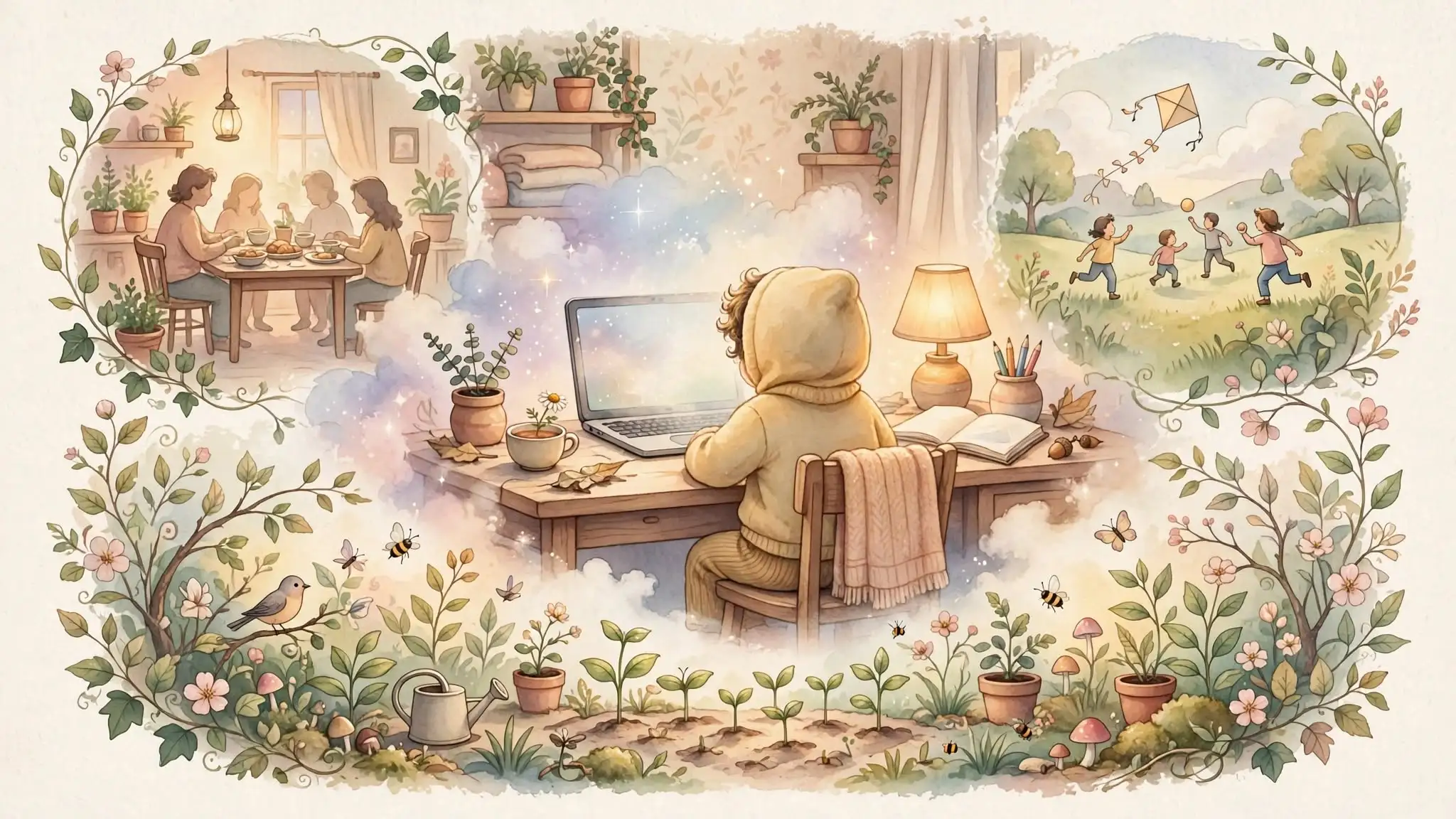
A 12-year-old types a perfect prompt into an AI assistant. The AI generates a flawless essay in seconds. The child smiles, copies, pastes, and submits. No frustration. No struggle. No learning. The child has mastered the tool—but has mastered nothing about themselves.
That is the problem with computer literacy alone.
Computer literacy teaches children to use tools. It teaches them to type, code, navigate software, and generate content. These skills are essential. They open doors. They create opportunities. They empower children to participate in the modern world.
But they are no longer enough.
Artificial intelligence is now writing code, generating content, and performing tasks that once required human intelligence. In this new reality, the most valuable skills are not technical. They are human: empathy, self-regulation, critical thinking, collaboration, and respect.
These are not “soft skills.” They are foundation skills—the ones that determine whether a child will thrive in the age of AI or simply become a user of it.
AI changes this equation.
The Consequence-Free Skill
You can teach a child to code. You can teach them to prompt an AI. You can teach them to generate a perfect essay. But you cannot teach them to persist when the AI gives them nothing. You cannot teach them to collaborate when the screen is their only companion. Its “well done” is a generated sentence, not a teacher’s genuine pride.
When children practice skills mostly in consequence-free environments, three things fade.
1. Noticing need fades. In real life, need is often quiet—a sibling struggling with homework, a grandparent moving slower, a friend feeling left out. AI need is announced: “I need more information.” The child learns to wait for explicit requests, not notice implicit ones.
2. Tolerating effort fades. Real growth costs—time, frustration, sweat, failure. You struggle with a math problem until it makes sense. You rewrite a paragraph until it says what you mean. AI help is instant and effortless. The child learns that learning should feel easy, not that struggle is the path to mastery.
3. Self-regulation fades. Real discipline requires pausing, breathing, and choosing a response—not because a machine tells you to, but because you know how to hold yourself. When everything is instant, the muscle of self-control atrophies.
Key takeaway: Computer literacy teaches children to use machines. Foundation skills teach children to be human.
What Research Says
A growing body of research confirms that technical skills alone are insufficient for thriving in the age of AI.
The OECD (2025) highlights that social and emotional skills—including empathy, self-regulation, and collaboration—are increasingly predictive of academic and life success, often more than cognitive skills alone.
UNICEF (2025) emphasizes that children’s agency and participation must include opportunities to contribute to family and community life, not just consume personalized services. When children only interact with screens, they lose the ability to navigate the messiness of human relationships.
The World Economic Forum (2025) lists empathy, active listening, and self-awareness as top skills for the future workforce—skills that AI cannot replicate.
Dweck (2006) demonstrated that a growth mindset—the belief that abilities can be developed through effort—is essential for resilience and long-term success. When AI removes the struggle, it removes the opportunity to develop this mindset.
The Lancet Child & Adolescent Health (2026) warns that when AI provides endless support without ever needing support back, it models a one-way relationship—children receive care but never practice giving care that requires attunement.
Key takeaway: You cannot learn to persist if nothing is hard. You cannot learn to collaborate if you only work alone. You cannot learn to regulate if everything is instant.
What Parents Can Do for Foundation Skills
1. Protect struggle — Let children struggle a little. Age-appropriate challenges that require effort: a puzzle that takes time, a math problem that requires thinking, a paragraph that needs rewriting. Not for punishment, but because “struggle is how we grow.”
2. Protect noticing — Play “What do you notice?” at home, park, market. No fixing required, just noticing. “What do you see?” “What do you think is happening?” “What do you wonder?” This builds the habit of curiosity and observation.
3. Protect collaboration — Create opportunities for real teamwork. Chores that require cooperation: cooking a meal together, cleaning a room together, planning a family outing. Not alone, but together. “We help each other live.”
4. Protect self-regulation — Practice pausing. Before reacting, before answering, before giving up: “Let us pause and breathe.” Build the habit of choice, not impulse.
5. Protect gratitude from living beings — A teacher’s smile, a friend’s relief, a sibling’s laughter. These are truer rewards than points or badges. Name them: “Look, she is smiling because you helped.”
Key takeaway: Computer literacy is a tool. Foundation skills are the hand that holds the tool.
The Discipline We Still Need
Computer literacy is a discipline. It requires focus, practice, and persistence. And this discipline is valuable. But we need another discipline—a deeper one.
We need the discipline of:
- Pausing before reacting—not being controlled by emotions
- Listening to understand—not just to reply
- Asking thoughtful questions—not just giving answers
- Collaborating with respect—not just competing
- Making ethical judgments—not just following instructions
This is not a “soft” discipline. It is the hardest discipline of all. And it is the one that will determine whether children thrive or simply survive in the age of AI.
Key takeaway: Computer literacy teaches children to use tools. Discipline teaches children to use themselves.
What About You?
When did your child last struggle with something and keep going? What helped them persist? When did they notice someone needed help without being asked? Share below.
About the Authors
Dr. Shaheen Pasha is a Professor of Special Education with over 35 years of teaching, research, and academic leadership experience. She served as Professor and Chairperson of the Department of Special Education at the University of Education, Lahore. She earned her Ph.D. in Special Education from the University of Southampton, UK. She has published more than 35 research papers and co-authored two books. Her expertise lies in child development, cognitive growth, and special education.
Dr. M. Anwar-ur-Rehman Pasha (widely recognized in academic circles as Dr. M. A. Pasha) is a Professor of Computer Science with over 35 years of post-graduate teaching, research, and educational management experience. He earned his Ph.D. in Computer Science from the University of Southampton, UK in 1996. His research focuses on Artificial Intelligence, Human-Computer Interaction, and Computational Thinking. He has served on different academic and administrative positions and has published two books and over 30 research articles.
Together, they bring 70 years of combined wisdom to help parents raise capable, thoughtful children in the age of AI.
References
Dweck, C. S. (2006). Mindset: The new psychology of success. Random House.
Eisenberg, N., et al. (2019). Prosocial development. In Handbook of Child Psychology.
Ha, T., et al. (2026). How interactional AI may alter adolescent relational learning and mental health. The Lancet Child & Adolescent Health.
OECD. (2025). How’s life for children in the digital age? OECD Publishing.
UNICEF. (2025). Guidance on AI and children: Version 3.0. UNICEF.
World Economic Forum. (2025). Future of Jobs Report 2025. WEF.
Denham, S. A., et al. (2003). Emotional development in young children. Guilford Press.
Grusec, J. E., & Davidov, M. (2010). Integrating different perspectives on socialization theory and research: A domain-specific approach. Child Development, 81(3), 687-709.