
A mother recently told me about her four-year-old daughter. The girl had learned to say “Alexa, play my song.” One afternoon, she looked at her mother and said, “Alexa is my friend.”
The mother laughed at first. Then she paused. Her daughter was not joking. She genuinely believed the device was a friend.
The mother asked me: “Is that a problem?”
I understood her uncertainty. Her daughter is not yet in school. She cannot read. She does not have a smartphone. Most AI literacy programs are designed for children aged eight and above. So what is a parent supposed to do when AI is already part of a four-year-old’s life?
This is the question we must confront.
In our previous blogs, we have explored AI literacy as prompting, creating, and questioning. But those frameworks assume a child who can read, type, and reason abstractly. They assume a child who is already eight.
What about the children who are two? Three? Five? Seven?
The Gap Nobody Is Talking About
Most AI literacy education begins in upper primary school. The European Commission and OECD’s AI Literacy Framework, UNESCO’s AI Competency Framework, and most national curricula target learners aged eight and above.
Yet children encounter AI long before they can read.
A 2026 project at the University of Buffalo, “AI & Me,” begins with a stark observation: “AI is already part of kids’ everyday lives—showing up in the videos they watch, the apps they use, and the ‘smart’ tools adults rely on. Yet most AI education is designed for older students, leaving families and early-grade teachers with few age-appropriate, trustworthy ways to help young children understand what AI is” .
The same gap appears in academic research. A 2026 systematic review of early childhood AI literacy found that the field is “heavily defined by ‘Tool-Driven’ and ‘Adult-Centric’ biases,” where “educational goals are frequently determined by what robots can do, or by simply watering down general adult standards, rather than by how young children actually think and develop” .
In other words: we are giving young children AI tools without giving them the conceptual foundation to understand what those tools are.
Key takeaway: AI literacy begins at age eight. But AI experience begins at age two. That gap is where confusion takes root.
Why This Gap Matters
A child who cannot read but talks to a voice assistant is forming beliefs about the world. She is learning that machines respond to her voice. She is learning that asking produces answers. She may be learning—incorrectly—that the machine is a person, a friend, or an authority.
Research on early childhood AI literacy identifies three core ideas that children as young as four can understand when taught appropriately:
- AI obeys instructions.
- AI is not sentient.
- AI supports people .
These are not abstract technical concepts. They are foundational truths about the nature of the systems children already encounter daily.
Yet without intentional teaching, children form their own conclusions. They may conclude that Alexa is a friend. They may believe the robot has feelings. They may trust the first answer a device gives them, never learning that AI can be wrong.
A 2025 study of Chinese preschoolers validated a three-factor structure for early AI literacy—ethics, cognition, and application—demonstrating that children as young as three already possess “nascent AI literacy” that is informal and untaught. The question is not whether children are learning about AI. It is whether they are learning accurate, empowering lessons or confusing, potentially harmful ones.
Key takeaway: Young children are already learning about AI. The question is what they are learning—and whether we are guiding them.
What Early AI Literacy Actually Looks Like
The good news is that developmentally appropriate AI literacy for young children does not look like computer science lessons. It looks like play.
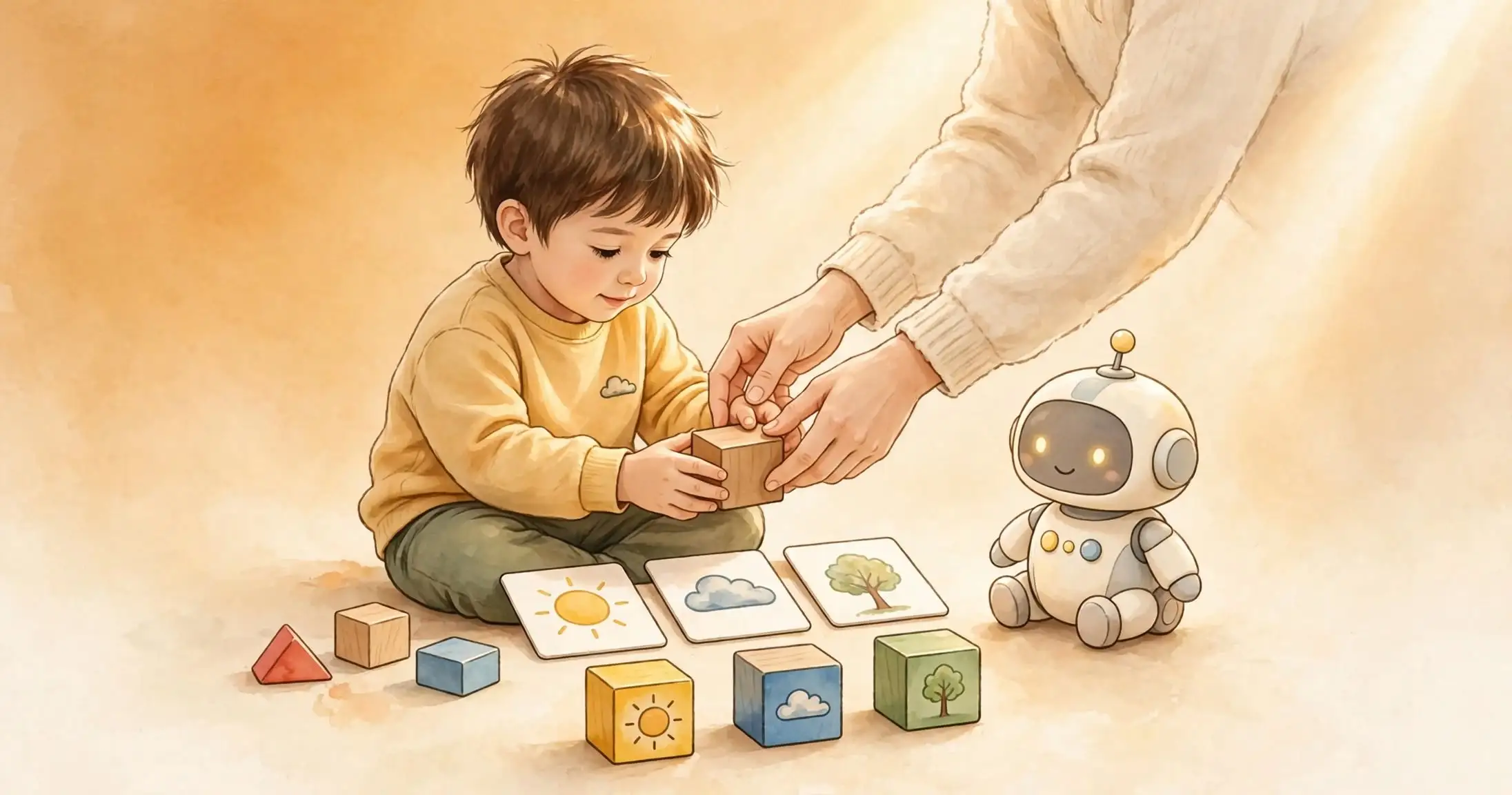
The “Play with AI” (PL-AI) curriculum, developed for pre-kindergarten and kindergarten, introduces foundational AI concepts through unplugged play—children composing and testing “how-to” algorithms, tangible coding with floor robots, and guided dialogue with a social AI robot. The curriculum situates AI not as an abstract technology but as a “human-designed, instruction-following system,” countering interpretations of AI as “autonomous or magical” .
The design principles are simple and powerful: embodied play, tangible coding, guided dialogue, and teacher co-design .
Similarly, the “Demystifying AI for Young Learners” framework begins with unplugged play, moves to codable robots, and culminates in interactions with humanoid social robots. Through activities like “I Am a Robot” and “Code the Path,” children learn that AI follows instructions and does not think for itself .
The University of Duisburg-Essen’s KIKI project works with children aged 4–6 using wooden building blocks, picture cards, tactile games, and child-friendly digital applications to explore algorithms and machine learning in a playful way.
These are not watered-down adult lessons. They are designed for how young children actually learn: through play, story, and concrete experience.
Key takeaway: Early AI literacy is not about teaching children to code. It is about helping them understand—through play—that AI is a tool made by people, not a magic friend.
What Parents Can Do Right Now
You do not need a curriculum. You need conversations.
1. Ask simple questions.
When your child talks to Alexa, ask: “Do you think Alexa is a person? How does she know what to say?” When a learning app adapts to your child, ask: “How do you think the app knows what you like?”
2. Teach the three core ideas.
Repeat them often, in simple language:
- “AI follows instructions. People give it the instructions.”
- “AI is not alive. It does not have feelings, even if it sounds like it does.”
- “AI helps people. But people are still in charge.”
3. Be a guide, not an expert.
You do not need all the answers. You need curiosity. Say: “I wonder if that’s true. Let’s check together.”
4. Protect play and human connection.
AI pre-literacy matters. But it is not a substitute for human relationships. Children need time to play, explore, and connect with real people—experiences that teach them what it means to be human.
Key takeaway: You do not need to teach a class. You just need to start a conversation.
A Hopeful Conclusion
AI literacy is essential. But it cannot wait until age eight. Children are already learning about AI—from the moment they first speak to a device, watch a recommended video, or play with a smart toy.
We must meet them where they are. We must give them words for what they are experiencing. We must help them understand that AI is not magic, not a friend, and not an authority—it is a tool made by people, with strengths, limits, and flaws.
The children who learn these lessons early will grow up with a foundation of understanding that prepares them for everything that comes next. They will be less likely to be deceived, manipulated, or confused by systems they do not understand. They will be more likely to ask questions, seek evidence, and think critically.
The distinction to teach:
“Alexa can answer your questions. But the most important questions are the ones you ask yourself—and the ones you ask the people who love you.”
What About You?
Has your young child ever said something that made you wonder what they think AI is? Have you started talking to them about it?
Share your experience in the comments below. We read every single one.
About the Authors
Dr. Shaheen Pasha is a Professor of Special Education with over 35 years of teaching, research, and academic leadership experience. She served as Professor and Chairperson of the Department of Special Education at the University of Education, Lahore. She earned her Ph.D. in Special Education from the University of Southampton, UK. She has published more than 35 research papers and co-authored two books.
Dr. M. Anwar-ur-Rehman Pasha (widely recognized in academic circles as Dr. M. A. Pasha) is a Professor of Computer Science with over 35 years of post-graduate teaching, research, and educational management experience. He earned his Ph.D. in Computer Science from the University of Southampton, UK in 1996. His research focuses on Artificial Intelligence, Human-Computer Interaction, and Computational Thinking. He has published two books and over 30 research articles.
Together, they bring 70 years of combined wisdom to help parents raise capable, thoughtful children in the age of AI.
References
Buffalo University. (2026). AI and Me: Advancing Responsible AI Literacy for Young Children. https://www.buffalo.edu/undergrad-research/opportunities.host.html/content/shared/www/undergrad-research/research-opportunities/ai-and-me-advancing-responsible-ai-literacy-for-young-children.detail.html
Lee, J. (2026). Play with AI (PL-AI): A play-centered, design-based curriculum for AI literacy in pre-K and kindergarten. Computers and Education: Artificial Intelligence. https://www.sciencedirect.com/science/article/pii/S2666920X26000317
Lee, J. (2026). Demystifying AI for Young Learners. In Curriculum and Strategies for Early Childhood Education. Taylor & Francis. https://www.taylorfrancis.com/chapters/edit/10.4324/9781003607304-7/demystifying-ai-young-learners-joohi-lee
Xiong, X. B., Cao, S., Gao, T., Luo, W., He, H., & Li, H. (2026). AI literacy in Chinese preschoolers: Evidence from scale validation study. Early Education and Development.
Framing early childhood AI literacy: What did the literature review tell us? (2026). AI, Brain and Child. https://link.springer.com/article/10.1007/s44436-026-00028-4
UNICEF. (2025). Guidance on AI and children: Version 3.0. UNICEF Office of Strategy and Evidence Innocenti. https://www.unicef.org/innocenti/reports/policy-guidance-ai-children