Pakistan frequently encounters global education ideas: learning poverty, foundational learning, competency-based curricula, digital learning, and, more recently, AI literacy. These ideas can bring useful attention to children’s learning, but they do not automatically fit Pakistan’s classrooms, homes, languages, teacher workforce, or unequal access to technology. The central question is therefore not whether Pakistan should learn from international experience, but how it can translate external ideas into policies that are meaningful for children aged 3–8.
This blog argues that Pakistan should move from policy borrowing to policy fit. Policy borrowing refers to adopting reforms developed elsewhere; policy fit requires critically examining whether an imported idea responds to local developmental, linguistic, cultural, institutional, and equity realities.
Why policies travel
Education policies rarely remain confined to national borders. Global organisations, donor agencies, consultants, international assessments, and education technology companies all help circulate ideas about what “good” education systems should do. Steiner-Khamsi (2014) explains that cross-national policy borrowing involves two connected processes: reception, which examines why a reform appears attractive in a new setting, and translation, which involves local adaptation, modification, or reframing of the imported reform.
Policy borrowing can be useful when it introduces evidence-based ideas, encourages reflection, or helps governments address neglected problems. For example, global attention to foundational learning has helped highlight that school enrolment alone does not guarantee reading, numeracy, or meaningful participation in learning. Similarly, growing interest in AI literacy can encourage education systems to prepare children for technological change.
However, borrowing becomes problematic when policies are treated as ready-made solutions. Portnoi (2016) notes that countries may adopt reforms as “quick fixes” or symbolic reforms for political reasons, or to comply with international mandates. In such cases, the appearance of reform can become more important than whether the reform improves children’s learning.
The risks of copying global models
Global models often carry assumptions that do not hold in every context. They may assume stable infrastructure, trained teachers, small class sizes, parental literacy, reliable electricity, internet access, English-language materials, and standardised assessment systems. When these assumptions are absent, reforms may be implemented unevenly or fail to reach the children who need them most.
Research on policy transfer raises ethical concerns about practices that are practically inappropriate, culturally insensitive, or imposed by more powerful countries or institutions (Tikly, 2014). Sutoris (2018) similarly argues that scaling educational interventions in the Global South requires attention not only to effectiveness but also to ethics, context, and the people affected by implementation. Policy borrowing can become coercive when external funding is contingent on adopting a particular reform package (Sutoris, 2018).
Pakistan’s experience with teacher education reform illustrates these risks. Niyozov and Khan (2024) found that a nationally mandated Bachelor of Education (Honours) programme was welcomed at the level of rhetoric but faced practical and sustainability challenges during implementation. Their study also found that discussions of colonial knowledge, North-South dependency, and local solutions were largely muted. They conclude that Pakistan should move beyond importing external “best practices” toward producing local solutions through an incremental, critical, and constructive approach.
From borrowing to translation
Policy borrowing is not inherently harmful. The problem arises when borrowing means copying without adaptation. Steiner-Khamsi (2014) argues that translation—the local adaptation and reframing of imported reforms—is essential. A policy may be inspired by international evidence but still need to be redesigned around local languages, teacher capacity, family practices, classroom realities, and available resources.
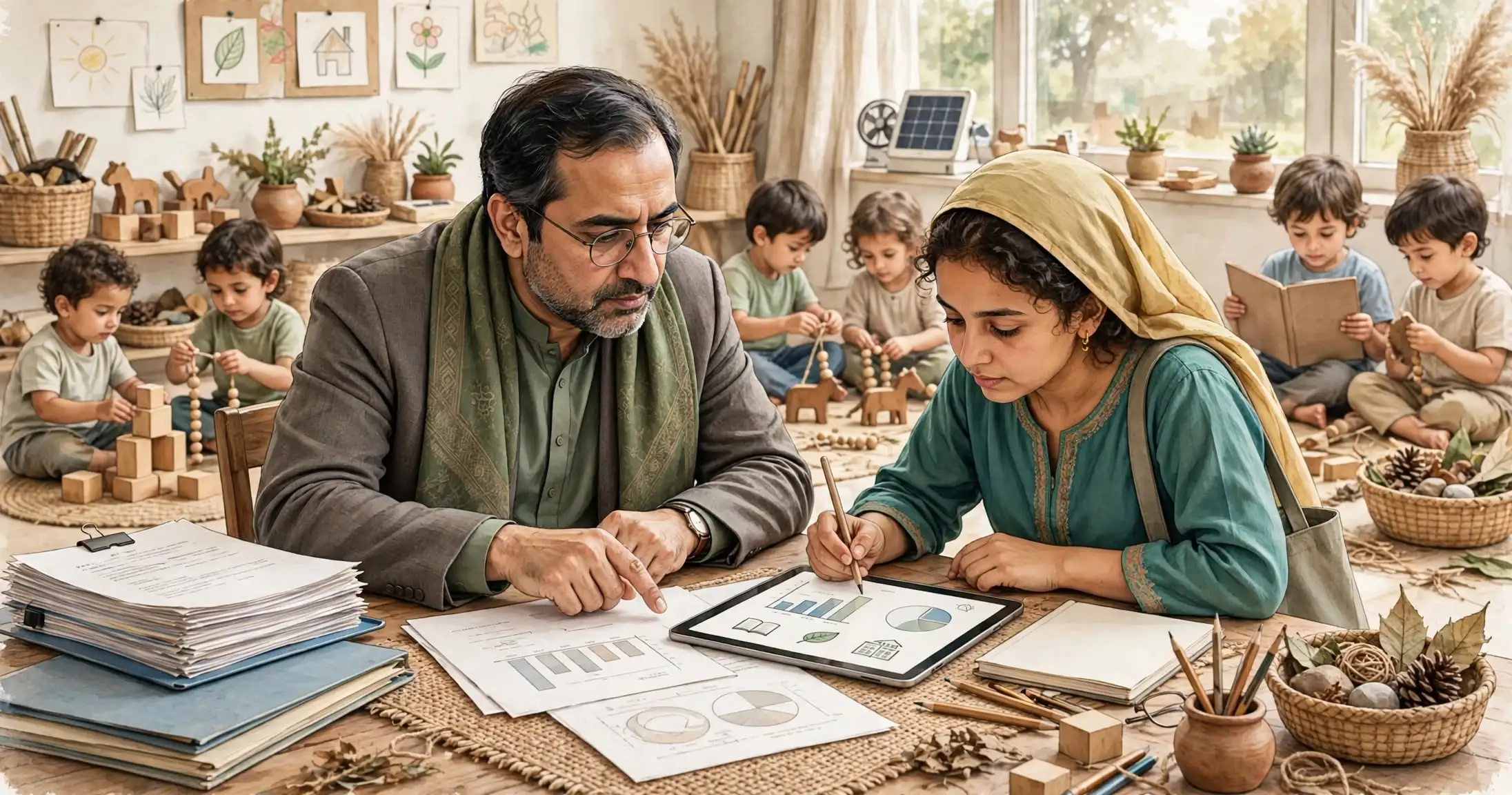
This distinction is especially important in early childhood education. Young children learn through relationships, language, play, and everyday experiences. A policy designed for a highly resourced, urban, English-medium preschool cannot simply be transferred to a rural government school, a low-cost private school, or a home-based learning environment. The policy goal may be similar—strong foundational learning—but the pathway must differ.
For Pakistan, policy fit would require asking questions such as:
- Does the reform recognise children’s home languages and build on them?
- Can teachers realistically implement it with existing training, time, and resources?
- Does it strengthen play, relationships, and language-rich learning rather than increase rote learning?
- Does it include children with disabilities and children in remote or under-resourced communities?
- Does it assume access to devices, electricity, internet, or English-language platforms that many families do not have?
- Does it improve children’s learning opportunities, or mainly improve policy documents and reporting systems?
AI pre-literacy: a case for caution and adaptation
AI literacy is now being promoted globally as an essential skill for the future. But much of the existing research and policy discussion assumes access to digital devices, formal schooling, and English-language environments. If Pakistan imports these models directly, AI pre-literacy may become another advantage for urban, affluent, English-medium learners while excluding children with limited connectivity, fewer books, or less exposure to digital technologies.
A more appropriate approach would begin with children’s everyday encounters with AI-shaped technologies: voice assistants, recommendation systems, talking toys, images, videos, and automated services. Young children do not need to code or operate complex tools to begin developing AI pre-literacy. They can learn through conversation, storytelling, role-play, and guided questioning: Who made this technology? What can it do? What can it not do? Can it make mistakes? Who benefits from it?
This approach makes AI pre-literacy more equitable because it does not depend primarily on expensive devices. It also aligns with the broader argument of this series: AI pre-literacy should be part of foundational learning, developed through language, relationships, play, and critical curiosity rather than through isolated technical instruction.
Building policy fit in Pakistan
Pakistan can strengthen policy fit by adopting a deliberate process of adaptation:
- Start with local evidence. Understand children’s actual learning conditions across provinces, languages, rural and urban settings, disability status, and household resources.
- Involve teachers and caregivers. Teachers, parents, community workers, and early childhood practitioners should help interpret and adapt policy rather than simply receive it.
- Use local languages as assets. Develop materials and teacher guidance in children’s home languages and use them to build bridges to Urdu, English, or other languages of instruction.
- Design for low-resource settings. Prioritise low-cost, low-connectivity, and offline strategies before assuming digital access.
- Pilot before scaling. Test reforms in diverse settings, learn from implementation, and revise them before national rollout.
- Measure children’s experiences. Evaluate whether reforms change classroom interaction, family engagement, inclusion, and learning opportunities—not merely whether documents or training sessions are completed.
- Retain what works locally. Policy fit does not mean rejecting all external ideas; it means combining useful global insights with local knowledge and practices.
Conclusion
Pakistan does not need to choose between global ideas and local realities. It needs a critical, adaptive approach that treats international evidence as a starting point rather than a final answer. Foundational learning and AI pre-literacy will be meaningful only when policies are translated into the languages, relationships, resources, and everyday contexts through which Pakistani children actually learn.
Continuity statement: The next blog, “From Policy Text to Children’s Lives: What Counts as Evidence of Foundational Learning Reform?”, will examine how Pakistan and other countries can assess whether reforms are changing children’s real learning opportunities rather than only improving policy documents.
References
Ali, S., & Tahir, M. S. (2009). Reforming education in Pakistan: Tracing global links. Journal of Research and Reflections in Education, 3(15), 1–16.
Niyozov, S., & Khan, A. W. (2024). Education faculty perspectives on a borrowed teacher education initiative in northern Pakistan: A call for engaging the discourses of policy borrowing and decolonization. Journal of Education in Muslim Societies, 5(2), 100–127.
Portnoi, L. M. (2016). Mapping educational policy borrowing and lending. In Policy borrowing and reform in education (pp. 147–173). Palgrave Macmillan. https://doi.org/10.1057/978-1-137-53024-0_6
Steiner-Khamsi, G. (2014). Cross-national policy borrowing: Understanding reception and translation. Asia Pacific Journal of Education, 34(2), 153–167. https://doi.org/10.1080/02188791.2013.875615
Sutoris, P. (2018). Ethically scaling up interventions in educational development: Case for collaborative multi-sited ethnographic research. Compare: A Journal of Comparative and International Education, 48(6), 884–902. https://doi.org/10.1080/03050068.2018.1481622
Tikly, L. (2014). The ethics and politics of the international transfer of educational policy and practice. Ethics and Education, 9(1), 84–96. https://doi.org/10.1080/17449642.2014.890323