
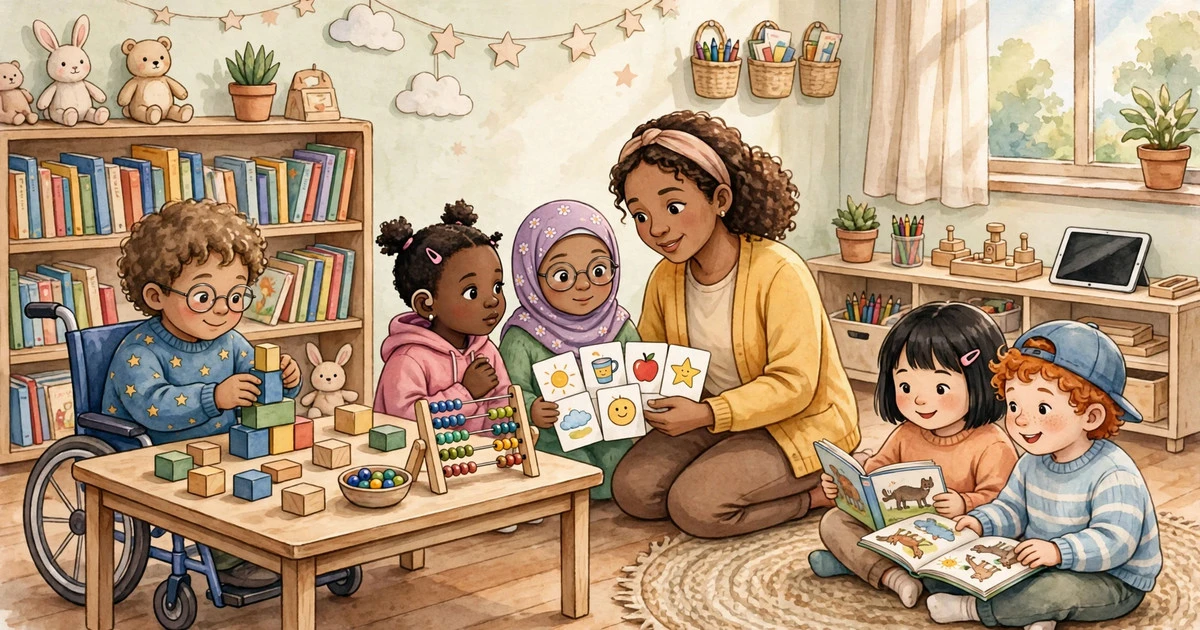
A common foundational learning agenda is valuable because it sets shared expectations for what young children should be able to do: communicate, read, count, reason, collaborate, and participate confidently in learning. But if “common” is interpreted as “identical,” it can become inequitable. Children aged 3–8 enter classrooms with different languages, family circumstances, disabilities, prior experiences, and access to books, digital tools, and supportive adults. An equitable early-learning agenda therefore needs common goals alongside differentiated support.
This blog argues that standardization and equity are not opposites. The challenge is to identify which elements of foundational learning should be universal—such as access to language-rich environments, responsive teaching, and opportunities for play—while allowing curriculum, materials, assessment, and technology use to respond to children’s contexts.
Why shared standards matter
Shared standards can protect children from fragmented, low-quality provision. They can clarify that early literacy, numeracy, oral language, social-emotional development, and well-being are not optional extras but central purposes of early education. They can also help governments allocate resources, train teachers, design materials, and monitor whether children are actually gaining foundational capabilities.
However, standards become problematic when they assume that all children begin from the same point. International evidence shows that early learning gaps are shaped by circumstances children cannot control, including socioeconomic status, home language, migration background, family structure, and place of residence (OECD, 2026). These differences are especially visible in emergent literacy and numeracy, the very domains that foundational learning agendas prioritise.
A standard that expects all children to reach the same benchmark by the same age may therefore describe an aspiration without explaining how unequal starting points will be addressed. Equity requires more than setting the same target; it requires allocating support according to need.
Language diversity is not a deficit
Language is one of the clearest examples of why a uniform approach can fail. Children whose home language differs from the language of schooling may need to learn new vocabulary, new ways of participating in classrooms, and a new language of instruction at the same time. The OECD reports that, on average across participating jurisdictions, children whose home language differed from the language of assessment showed lower performance in emergent literacy and numeracy, even after accounting for socioeconomic status (OECD, 2026).
This does not mean that multilingual children are less capable. It means that systems often fail to build bridges between children’s existing linguistic knowledge and the language used in school. Treating a child’s home language as a problem can undermine confidence, reduce participation, and make early learning feel alienating.
An equitable foundational learning agenda should treat multilingualism as a resource. Teachers can use children’s home languages to explain concepts, build vocabulary, involve families, and validate children’s identities. They can also provide structured support for the language of schooling through stories, songs, visual materials, peer interaction, and repeated opportunities to use new words in meaningful contexts.
Disability inclusion requires more than physical access
Inclusion is often reduced to placing children with disabilities in mainstream classrooms. But inclusion means more than proximity: it requires meaningful participation, individualised support, collaboration with families, and a culture in which difference is expected rather than treated as exceptional.
Research with early childhood educators identifies inclusion as a right to belong and participate fully, supported by modifications, relationships with families and specialists, and adequate professional learning (Munchan & Agbenyega, 2020). Underwood et al. (2012) similarly argue that equity means fair outcomes for each child rather than identical treatment for all children. Inclusive practice therefore requires differentiated instruction, accessible materials, flexible participation options, and systemic support for teachers.
Young children with disabilities continue to face significant barriers, particularly in low- and middle-income countries. Olusanya et al. (2024) argue that equitable early childhood development for children with disabilities requires a twin-track approach: strengthening universal systems while providing targeted disability-specific services. They also highlight the need for early intervention, family involvement, workforce training, clear funding mechanisms, and monitoring systems.
For foundational learning, this means that literacy and numeracy goals must be interpreted flexibly. A child may participate through speech, gesture, assistive technology, pictures, sign, or alternative communication. The purpose is not to make every child perform the same task in the same way, but to ensure that every child has genuine opportunities to communicate, learn, and participate.
The digital divide extends beyond devices
AI pre-literacy and digital learning raise new equity concerns. It is tempting to assume that providing tablets, applications, or internet access will close learning gaps. But the digital divide is not only about physical access to devices. It also includes differences in digital skills, meaningful use, family support, institutional capacity, and the quality of educational mediation (Heydon et al., 2024; Lee & Hatzigianni, 2026).
Research on virtual early childhood learning shows that families differ in linguistic, epistemological, and technological resources, and that equitable digital provision should include accessible devices, offline options, books, art materials, and family guidance (Heydon et al., 2024). Similarly, research on digital integration in early childhood education argues that equity requires attention to infrastructure, educator preparation, ethical safeguards, and coordinated family-school support (Lee & Hatzigianni, 2026).
This has direct implications for AI pre-literacy. If AI learning is designed around expensive devices, English-language applications, or home internet access, it may become another advantage for better-resourced children. If it is designed around conversation, stories, play, local languages, and low-tech activities, it can become part of a more inclusive foundational learning agenda.
What should be common—and what should adapt?
An equitable foundational learning agenda needs a clear distinction between universal principles and context-sensitive implementation.
| Universal commitments | Context-sensitive provision |
| Every child has access to responsive adults and meaningful learning relationships. | Teacher-child ratios, training, and support differ according to setting and need. |
| Every child develops oral language, early literacy, and early numeracy. | Languages of instruction, materials, and assessment reflect children’s home languages and local realities. |
| Every child has opportunities for play, exploration, and agency. | Play materials and activities draw on local cultures, games, stories, and environments. |
| Every child is included and able to participate. | Support, communication modes, and learning goals are individualised for children with disabilities. |
| Every child develops awareness of AI-shaped environments. | AI pre-literacy activities are adapted to available technology, language, and family circumstances. |
| Every child’s progress is understood through supportive assessment. | Assessment avoids high-stakes comparison and uses multiple, developmentally appropriate forms of evidence. |
This distinction allows systems to maintain ambition without imposing uniformity. It also shifts the question from “Are all children doing the same thing?” to “Are all children receiving the support they need to participate and learn?”
What this means for Pakistan
Pakistan’s linguistic diversity, rural-urban differences, uneven early childhood provision, and unequal access to technology make this question especially urgent. A single national framework can be useful if it establishes shared goals for foundational learning, but implementation must recognise that a child in a multilingual urban school, a rural community school, a low-cost private school, and a home-based learning setting may require different forms of support.
For AI pre-literacy, this means avoiding a one-size-fits-all model based on devices and English-language platforms. Instead, Pakistan could develop low-cost, multilingual, culturally grounded approaches that use stories, role-play, local examples, caregiver conversations, and teacher guidance to help children understand AI in everyday life.
Conclusion
One foundational learning agenda can serve all children only if it combines shared goals with equitable, flexible implementation. Common standards are useful for setting direction, but they cannot substitute for investment in teachers, families, inclusive classrooms, appropriate materials, and fair access to learning opportunities. Equity requires that children with different languages, abilities, and resources receive the support they need to reach meaningful learning goals.
Continuity statement: The next blog, “Policy Borrowing or Policy Fit? Rethinking Early Learning and AI Pre-Literacy in Pakistan,” will examine how Pakistan can decide whether international early-learning and AI-literacy approaches are appropriate for its developmental, linguistic, and equity realities.
About the Authors
Prof. Dr. Shaheen Pasha & Prof. Dr. Muhammad Anwar-ur-Rehman Pasha
Authors and education researchers working on children’s development, education, and the implications of artificial intelligence for the emerging AI-driven society.
References
Heydon, R., Akiwenzie, E., Cooper, E., Ghannoum, H., Havord-Wier, B., Johns, B., MacAlpine, K.-A., McKee, L., Nagle, J., Neeganagwedgin, E., Pawlick Potts, D., Poczobut, C., Coelho, C. R., Stooke, A., Tran, A., & Zhang, Z. (2024). Guidelines for virtual early childhood and family learning: An equity, diversity, inclusion, and decolonization-informed systematic review of the literature. Contemporary Issues in Early Childhood, 25(1), 3–24. https://doi.org/10.1177/14687984231188466
Lee, L., & Hatzigianni, M. (2026). From resistance to readiness: An ecological governance analysis of digital integration in U.S. early childhood education. International Journal of Early Childhood. Advance online publication. https://doi.org/10.1007/s13158-026-00542-9
Munchan, L., & Agbenyega, J. S. (2020). Exploring early childhood educators’ experiences of teaching young children with disability. Australasian Journal of Early Childhood, 45(3), 280–291. https://doi.org/10.1177/1836939120944633
OECD. (2026). Equity gaps in early learning and development. In Building strong foundations for life. OECD Publishing.
Olusanya, B. O., Wright, S. M., Nair, M. K. C., Boo, N.-Y., Halpern, R., Kuper, H., Abubakar, A. A., Almasi, N., Breinbauer, C., de Vries, P. J., Gladstone, M., Kancherla, V., Kakooza-Mwesige, A., Maphula, A., Mulaudzi, M. C., Newton, C. R., Siddiqi, K., & Smythe, T. (2024). Early childhood development strategy for the world’s children with disabilities. Frontiers in Public Health, 12, Article 1397493. https://doi.org/10.3389/fpubh.2024.1397493
Underwood, K., Valeo, A., & Wood, R. (2012). Understanding inclusive early childhood education: A capability approach. Contemporary Issues in Early Childhood, 13(4), 290–299. https://doi.org/10.2304/ciec.2012.13.4.290