
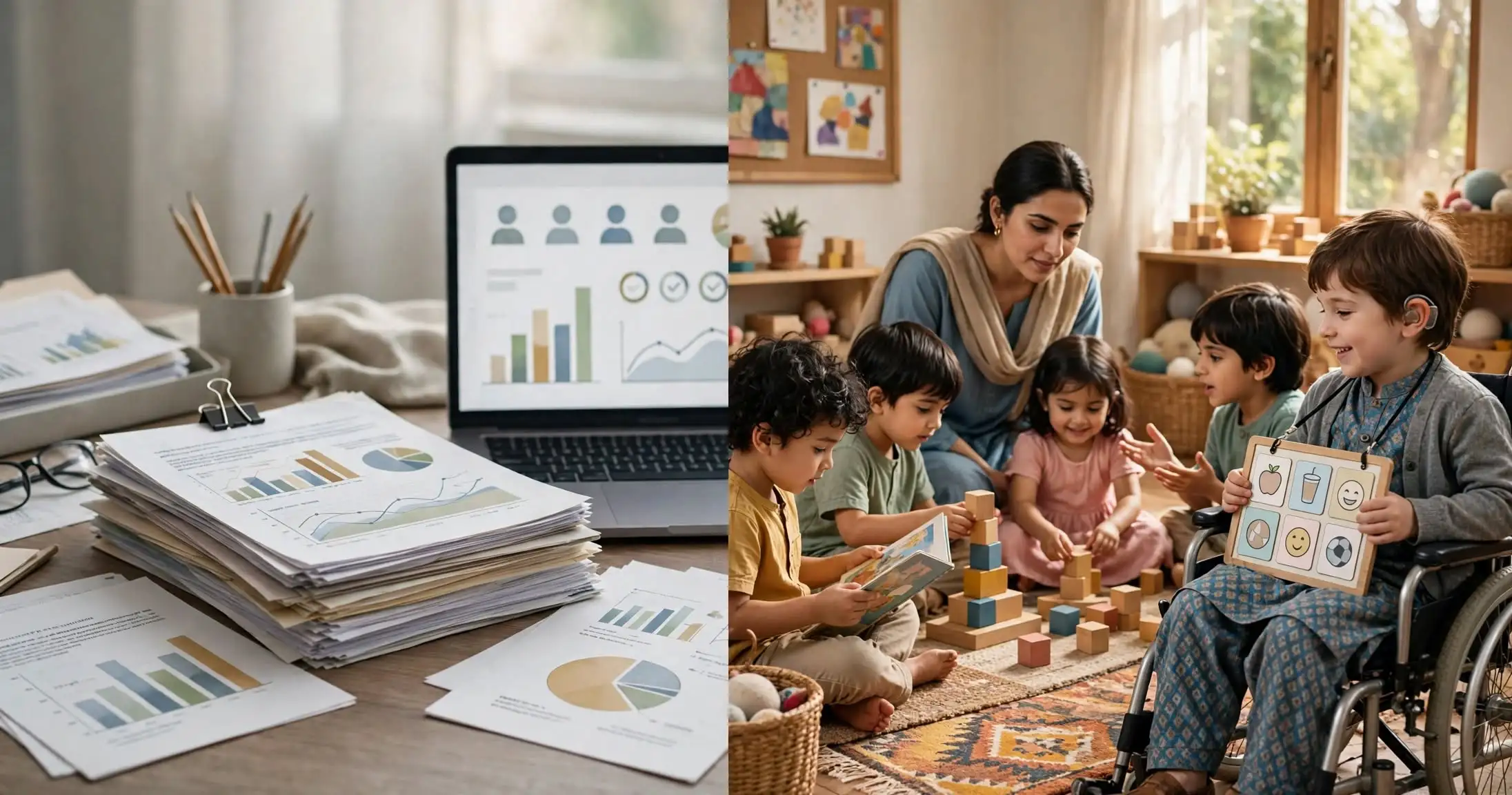
Governments often measure education reform by what can be counted easily: curriculum documents revised, teachers trained, textbooks distributed, schools visited, or children enrolled. These indicators are useful, but they do not answer the most important question: has the reform changed children’s opportunities to learn? For foundational learning among children aged 3–8, evidence must move beyond policy text and administrative compliance to examine classrooms, homes, teacher practice, inclusion, and children’s everyday experiences.
This blog argues that meaningful evidence of foundational learning reform should show whether children have more language-rich, playful, responsive, and inclusive opportunities to develop literacy, numeracy, and AI pre-literacy.
The problem with compliance-based evidence
A reform may appear successful on paper while having little effect in children’s lives. A curriculum may be revised, teachers may attend workshops, and schools may submit reports, yet classrooms may continue to rely on rote memorisation, children’s home languages may remain excluded, and children with disabilities may still be unable to participate fully.
Research on implementation highlights this gap. A systematic review of 79 education intervention studies found that 85% reported measuring implementation, but most relied on a narrow fidelity framework focused on adherence to the intended programme design (Dallavis et al., 2025). Classroom observations were the most common measurement approach, followed by teacher logs and surveys; however, only 23 of the 66 studies measuring implementation included fidelity data in analyses of student outcomes (Dallavis et al., 2025).
This matters because implementation is not simply whether a programme was delivered as planned. Children’s learning depends on whether teachers understand the reform, adapt it appropriately, use it in meaningful interactions, and receive ongoing support. A narrow focus on adherence can obscure the mechanisms through which reforms affect learning and lead to incomplete explanations of programme effectiveness (Dallavis et al., 2025).
Evidence should begin in classrooms
The first place to look for evidence is the classroom. Rather than asking only whether teachers received training, policymakers should ask whether teachers can use the reform in daily practice: Do they ask open-ended questions? Do they extend children’s language? Do they use play to develop literacy and numeracy? Do they give useful feedback? Do they adapt activities for children with different needs?
Classroom observation is important because it captures the interactions through which young children learn. But observation must go beyond checking whether a teacher followed a lesson plan. It should examine the quality of interactions, children’s participation, use of materials, opportunities for talk, and responsiveness to children’s ideas.
Evidence should also include children’s voices and experiences. Young children may not evaluate policy in formal terms, but they can show whether learning is meaningful through their engagement, questions, confidence, persistence, and participation. Observing whether children are active participants—or merely silent recipients of instruction—provides important evidence about whether reform has reached them.
Formative assessment as evidence in use
Assessment is often treated as a final measurement of learning. In early childhood, however, assessment should primarily be formative: teachers observe children, interpret what they know, and adjust teaching accordingly. Formative assessment is a process in which teachers and children gather, interpret, and use evidence about learning to guide further learning during instruction (What Works Clearinghouse, 2026).
The evidence for formative assessment is promising. A review of 23 rigorous studies found that formative assessment had a positive effect on student academic achievement, with an average effect size of 0.33 across studies that provided sufficient information for calculation (What Works Clearinghouse, 2026). A meta-analysis of 258 effect sizes from 118 primary studies similarly found an overall effect size of 0.25 for formative assessment on K–12 achievement (Hsu et al., 2024).
In early childhood settings, formative assessment should not mean testing young children with worksheets or formal examinations. It should include observation during play, conversations, portfolios, learning stories, photographs, samples of children’s work, and structured opportunities for children to demonstrate understanding. MacDonald (2007) found that pedagogical documentation in kindergarten classrooms helped teachers use children’s learning as a basis for formative assessment and communicate learning to families.
However, assessment tools must be used carefully. A review of formative assessment tools in early childhood settings found that, although 22 tools had varying levels of psychometric evidence, only three had evidence of effectiveness for educator practice, and none had been rigorously evaluated against both teacher practice and child outcomes (NSW Department of Education, 2026). This warns against assuming that any checklist, app, or assessment tool automatically improves learning.
Evidence must include homes and communities
Foundational learning does not occur only in schools. Children’s language, early literacy, numeracy, and understanding of the world are shaped by caregivers, siblings, communities, religious and cultural practices, local stories, and everyday routines. Evidence of reform should therefore ask whether families and communities have been supported—not blamed or burdened.
Useful questions include:
- Are parents and caregivers given practical, culturally relevant ways to talk, read, and play with children?
- Are materials available in children’s home languages?
- Are families informed about children’s progress in ways that are accessible and respectful?
- Are community resources, such as libraries, local storytellers, and community workers, connected to early learning?
- Are children in remote, poor, or marginalised households reached, or does reform remain concentrated in better-resourced schools?
If a reform improves outcomes only for children who already have books, educated caregivers, stable internet access, and well-resourced schools, it may widen inequality rather than reduce it.
Evidence must show inclusion.
A foundational learning reform cannot be considered successful if it reaches only some children. Evidence should show whether children with disabilities, children from linguistic minorities, girls, children in poverty, children in rural areas, and children experiencing displacement are genuinely participating.
This requires more than counting enrolment. It requires asking whether children with disabilities have accessible materials, communication options, trained teachers, and opportunities to participate in play and learning. It also requires asking whether multilingual children can use their home languages as resources and whether girls and children from marginalised communities experience classrooms as safe and welcoming.
Inclusion should therefore be treated as an outcome of reform, not merely a principle stated in policy. Evidence should capture whether children are present, participating, supported, and progressing.
AI pre-literacy needs careful evidence
As AI becomes part of children’s environments, reforms may introduce AI literacy programmes, digital tools, or teacher training. But evidence of success should not be limited to the number of tablets distributed or the number of teachers who attended an AI workshop.
More meaningful evidence would ask whether children are developing age-appropriate awareness of AI: Can they notice when a technology is responding to them? Can they ask simple questions about how it works? Can they recognise that AI outputs may be incomplete, biased, or incorrect? Are teachers confident and supported to discuss AI without relying on devices?
Evidence should also examine unintended effects. Does AI-related instruction replace play, conversation, and relationships? Does it privilege children with devices and connectivity? Does it reinforce English-language or urban-centred assumptions? If so, the reform may be expanding digital inequality rather than preparing all children for an AI-shaped world.
What good evidence looks like
Evidence of foundational learning reform should combine several forms of information:
- Classroom evidence: Observations of teacher-child interactions, children’s participation, language use, play, and instructional quality.
- Learning evidence: Developmentally appropriate measures of oral language, early literacy, numeracy, problem-solving, and social-emotional learning.
- Implementation evidence: Information on whether teachers understand, adapt, and sustain the reform in real classrooms.
- Equity evidence: Disaggregated data by language, disability, gender, location, income, and school type.
- Family and community evidence: Evidence of caregiver engagement, access to materials, and continuity between home and school.
- Assessment evidence: Use of formative assessment to guide teaching rather than merely rank children.
- AI pre-literacy evidence: Children’s developing awareness, questioning, and safe engagement with AI-shaped environments.
Conclusion
The success of foundational learning reform cannot be judged by the number of policies produced or training sessions completed. It must be judged by whether children’s everyday learning opportunities have changed: whether they have more chances to talk, play, read, count, ask questions, receive feedback, and participate fully in learning. Evidence should connect policy intentions to classrooms, homes, and communities—and should pay particular attention to children whose needs are most often overlooked.
Continuity statement: The final blog, “Beyond Curriculum: Literacy, Numeracy, and AI Pre-Literacy in Context-Sensitive Early Learning Reform,” will bring together the arguments of this series and propose an integrated, equitable approach to foundational learning for children aged 3–8.
References
Dallavis, C., et al. (2025). Analyzing the conceptual and methodological tensions of measuring implementation in quantitative educational research: A systematic review of IES-funded intervention studies. Educational Evaluation and Policy Analysis. Advance online publication.
Hsu, T.-C., et al. (2024). The impact of formative assessment on K–12 learning: A meta-analysis. Educational Research and Evaluation, 29(7–8), 431–457. https://doi.org/10.1080/13803611.2024.2363831
MacDonald, M. (2007). Toward formative assessment: The use of pedagogical documentation in early elementary classrooms. Early Childhood Research Quarterly, 22(2), 232–242. https://doi.org/10.1016/j.ecresq.2007.04.002
NSW Department of Education. (2026). Formative assessment practices in early childhood settings: Evidence and implementation in NSW. Centre for Education Statistics and Evaluation.
What Works Clearinghouse. (2026). Formative assessment and elementary school student academic achievement: A review of the evidence. Institute of Education Sciences, U.S. Department of Education.