
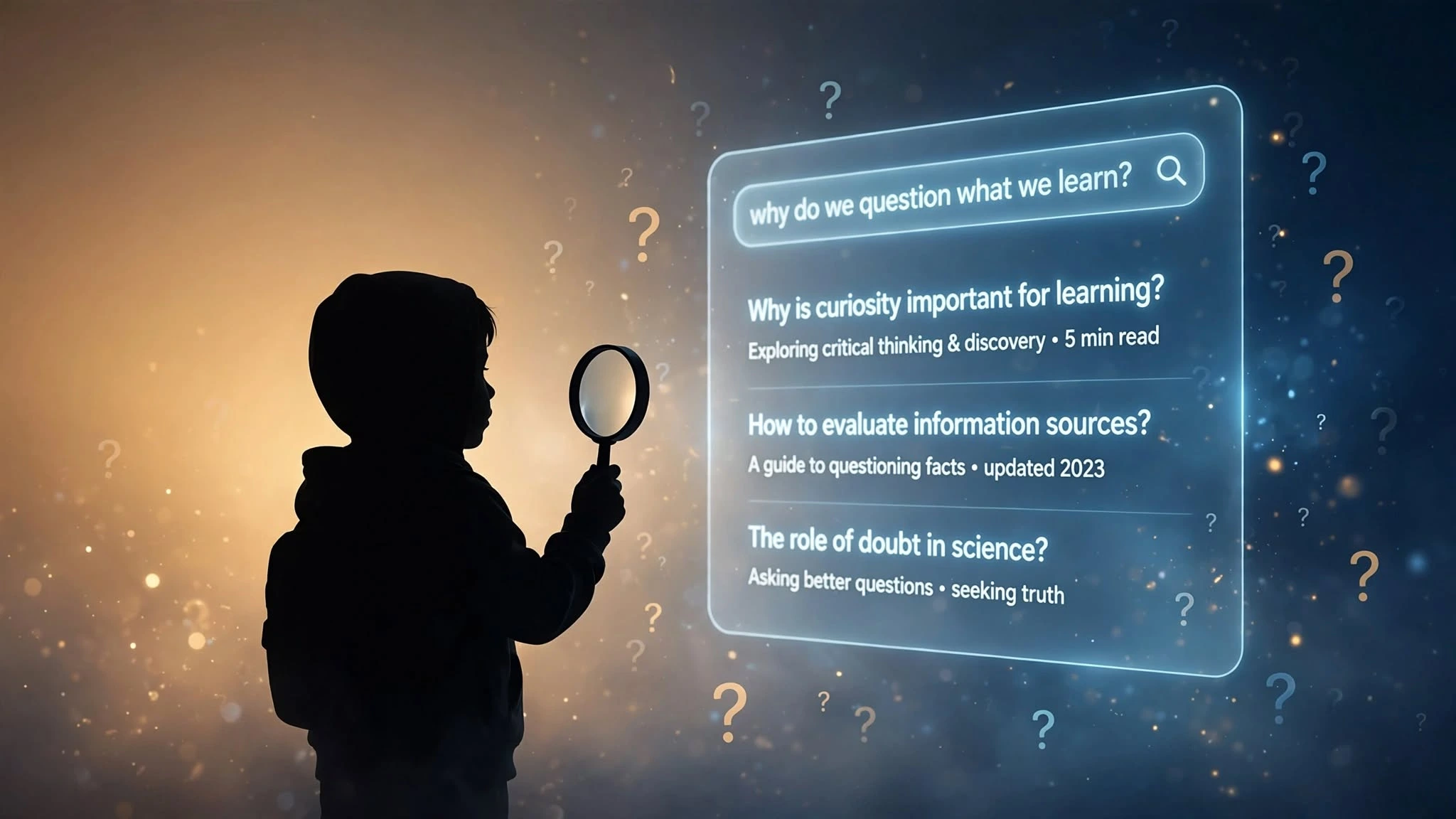
Digital Literacy and the Search Engine Child: How IT Literacy Taught Us to Find Answers
A teacher recently told me about her 10-year-old student. The boy had a science project due. He opened Google, typed in the question, clicked the first link, copied the text, and closed the laptop. Three minutes. Done.
When she asked him how he knew the information was reliable, he looked confused.
“It was the first result,” he said. “Google always shows the right answer.”
His confidence was not unusual.
In our first blog, Why Modern Childhood Needs New Parenting Wisdom, we argued that parenting wisdom must evolve because childhood itself is changing. In our second blog, The Invisible Roommate, we explored how AI shapes the environment children inhabit. In our third blog, When AI Gets Too Close, we examined the risks of AI moving into children’s emotional lives. In our fourth blog, The Synthetic Mirror, we explored how algorithmic systems reshape children’s self-image. In our fifth blog, The Machine Tongue, we examined how AI friendships are rewiring human connection.
Now we turn to a question that predates generative AI but has become even more urgent in its shadow:
What happens when children learn to find answers—but never learn to question them?
What Is the Search Engine Child?
The Search Engine Child is a child who has grown up believing that finding information is the same as understanding it. They have learned to type, click, and copy. They have not learned to evaluate, question, or verify.
They are fluent in the mechanics of search. They are not fluent in the judgment that search requires.
This distinction matters. A 2025 study of online search behaviors for information literacy education found that despite high levels of confidence in their own digital abilities, many young people lack the critical skills needed to evaluate information effectively (Beriain-Bañares et al., 2025). Digital natives—children who have grown up with technology—are especially vulnerable to over-estimating their critical abilities. Experience and use of the internet seems to be the primary factor in shaping trust in the internet, not the ability to evaluate it.
A 2024 study examining how eight-year-old students engage in teacher-guided digital online reading during internet searches found that children’s digital literacy skills are still developing, and they require explicit guidance to navigate online information effectively (Wennås Brante et al., 2024). The research focused on the students’ digital literacy and how they engage with teacher-guided searches.
In the age of abundant digital content, children face the challenge of developing new information literacy competencies, particularly those pertaining to evaluating online information (Chourio-Acevedo et al., 2024).
Key takeaway: The Search Engine Child can find answers quickly. But finding is not the same as understanding. And trusting the first result is not the same as knowing the truth.
How We Got Here: The Promise and the Problem
For decades, we taught children digital literacy as the ability to use technology. We taught them how to type, how to search, how to use software. We assumed that if they could operate the tools, they would naturally develop the judgment to use them wisely.
That assumption was wrong.
A 2025 study analyzing the training, self-perception, and information competence of young people found that they have a high self-perception of their search strategy skills (Beriain-Bañares et al., 2025). They believe they are good at searching. However, these findings contrast with theories that consider being a digital native implies being competent in a technological environment.
In other words: Children think they are skilled because they are confident. But confidence is not competence.
This is what researchers call the “digital native” fallacy. Just because children grow up with technology does not mean they understand it. Just because they can use a search engine does not mean they can evaluate what they find.
A 2025 paper on children’s conversational voice search as learning critically reviews the intersection of searching and learning among children in the context of voice-based conversational agents (Yi, 2025). It highlights that children increasingly turn to tools not designed to search for information for educational purposes.
Primary school students increasingly encounter artificial intelligence in subtle, often invisible ways—through search engines, recommendation systems, and automated summaries (Muis et al., 2026). These systems shape what children see and how they understand the world, often without their awareness.
Key takeaway: We taught children to use search engines. We forgot to teach them to question what they find.
What the Research Shows
- Children Trust the First Result
A UNESCO survey found that 60% of children believe the first result a search engine returns is always the most appropriate (UNESCO, 2025). This is not a sign of laziness. It is a sign of trust—and a misunderstanding of how search engines work.
Search engines rank results based on algorithms, not accuracy. The first result is not necessarily the most reliable. It is simply the one the algorithm has determined is most relevant—based on factors like popularity, keywords, and user behavior. - Children Lack Critical Evaluation Skills
Despite high levels of confidence in their digital abilities, studies have found that many young people lack the tools and abilities to evaluate information effectively, in part due to their relatively limited development and life experience (Beriain-Bañares et al., 2025).
Pedagogical interventions have been shown to improve the ability of young people to judge the credibility and evaluate the truth value of information online (Muis et al., 2026). But without explicit teaching, these skills do not develop automatically. - Search Engines Lack Transparency
A 2024 study on search engine literacy found that a lack of transparency in how search results are prioritized inhibits children from having direct access to information that may provide valuable insight and aid in the search process (Chourio-Acevedo et al., 2024). Children cannot evaluate what they cannot see.
The researchers posit that simple visual cues can be provided to reveal those characteristics, helping children understand why certain results appear and others do not. - Social Networks Are Replacing Search Engines
Research presented at a 2025 conference found that search engines are not always students’ first choice; social networks often play a leading role (Murgia et al., 2025). Children increasingly turn to tools not designed for educational purposes, making search and media literacy skills even more critical.
Key takeaway: Children trust search engines without understanding them. They need to learn how search works—and how to question what they find.
What Children Lose When They Only Know How to Find
When children learn to find answers but never learn to question them, they lose something essential.
Loss Explanation
Critical Thinking: Children never learn to ask whether information is true, reliable, or biased
Intellectual Humility: Children never learn that they might be wrong—or that the first answer might not be the right one
Curiosity: Children stop asking “why” because they have already found “what”
Patience: Children expect instant answers and become frustrated when they have to work for understanding
Depth: Children skim the surface instead of diving deep
The problem is not that children use search engines. The problem is that they use them without understanding them.
As one researcher noted, search engines have been used to facilitate fact-finding in school teaching, but learning to use search engines to increase one’s understanding has received less attention (Yi, 2025).
Key takeaway: Finding answers is not the same as understanding them. When children only learn to find, they never learn to think.
What Parents Can Do
- Teach the Difference Between Finding and Understanding
Help your child understand that finding information is not the same as understanding it. Just because you can find an answer does not mean you know what it means or whether it is true.
Action: Ask your child: “What did you learn from that search? Not just what did you find—what do you actually understand now?” - Question the First Result
Teach your child that the first result is not always the best result. Search engines rank results based on algorithms, not accuracy.
Action: Ask your child: “Why do you think this result came first? What makes it reliable—or not?” - Teach Search Engine Literacy
Search engine literacy is the knowledge of how search engines work and the skills to find, evaluate, and use information effectively (Chourio-Acevedo et al., 2024). This includes understanding findability, linguistic functions, query language, and ranking.
Action: Teach your child basic search strategies: using quotation marks for exact phrases, being aware of the web address and type of website, and using ‘find’ to locate keywords in the text. These simple skills can help children advance their online searching abilities. - Model Critical Evaluation
Show your child what it looks like to question information. When you search for something, think aloud: “I wonder if this source is reliable. Let me check who wrote it and when.”
Action: Make evaluation a habit. Before your child uses information from a search, ask: “Who wrote this? When was it published? Why should we trust it?” - Encourage Multiple Sources
Teach your child that one source is never enough. Encourage them to check multiple sources and compare what they find.
Action: Ask your child: “What does another source say? Do they agree? If not, why might that be?” - Talk About How Search Engines Work
Children need to understand that search engines are not neutral. They are designed by people, use algorithms, and prioritize certain results over others.
Action: Explain simply: “Search engines use computers to decide what to show you. They don’t always know what’s true—they just know what’s popular or what matches your words.” - Foster Curiosity, Not Just Answers
Encourage your child to ask “why” and “how”—not just “what.” Help them see that the best questions are often the ones that do not have easy answers.
Action: When your child finds an answer, ask: “What else do you wonder about this? What don’t you know yet?”
Key takeaway: Parents cannot remove search engines from their children’s lives. But they can teach children to use them wisely—and to question what they find.
A Hopeful Conclusion
The Search Engine Child is not a lost cause. Children can learn to question, evaluate, and think critically. They can learn that finding answers is not the same as understanding them.
But they need our help.
They need us to teach them that the first result is not always right. That search engines are not neutral. That information must be evaluated, not just consumed.
The goal is not to make children distrust technology. The goal is to make them thoughtful users of it.
The distinction to teach:
“A search engine can show you an answer. But only you can decide whether to trust it. Only you can ask the next question. Only you can keep wondering.”
What About You?
Has your child ever trusted a search result without questioning it? Have you noticed them treating the first result as the truth?
Share your experience in the comments below. We read every single one. Your story might help another parent recognize the Search Engine Child in their home.
About the Authors
Dr. Shaheen Pasha is a Professor of Special Education with over 35 years of teaching, research, and academic leadership experience. She served as Professor and Chairperson of the Department of Special Education at the University of Education, Lahore. She earned her Ph.D. in Special Education from the University of Southampton, UK. She has published more than 35 research papers and co-authored two books. Her expertise lies in child development, cognitive growth, and special education.
Dr. M. Anwar-ur-Rehman Pasha (widely recognized in academic circles as Dr. M. A. Pasha) is a Professor of Computer Science with over 35 years of post-graduate teaching, research, and educational management experience. He earned his Ph.D. in Computer Science from the University of Southampton, UK in 1996. His research focuses on Artificial Intelligence, Human-Computer Interaction, and Computational Thinking. He has served on different academic and administrative positions and has published two books and over 30 research articles.
Together, they bring 70 years of combined wisdom to help parents raise capable, thoughtful children in the age of AI.
References
Beriain-Bañares, A., de Vicente-Domínguez, A.-M., & Sierra-Sánchez, J. (2025). Analysis of the training, self-perception and information competence of young people in Spain in internet search strategies. SAGE Journals.
Chourio-Acevedo, L., et al. (2024). Evaluation of online inquiry competencies of Chilean elementary school students: A dataset. Data, 9(7), 85. https://doi.org/10.3390/data9070085
Muis, K. R., Pearson, H. A., Montazami, A., & Dubé, A. K. (2026). A design-based intervention to develop elementary students’ digital literacy skills. Journal of Experimental Education.
Murgia, E., Landoni, M., Huibers, T., & Pera, M. S. (2025). Enhancing children’s web searches through age-specific vocabulary reformulation. Conference paper.
UNESCO. (2025). Más de la mitad de las chicas y los chicos usa Inteligencia Artificial. UNESCO News.
Wennås Brante, E., et al. (2024). Eight-year-olds engaging in guided information searches with iPads: Dimensions of reading competence. International Journal of Child-Computer Interaction, 40. https://doi.org/10.1016/j.ijcci.2024.100653
Yi, S. (2025). Children’s conversational voice search as learning: A literature review. Information and Learning Sciences, 126(1-2), 8-28. https://doi.org/10.1108/ILS-04-2024-0058