
Last week, a young mother told me, “We are waiting for our son to be old enough for coding classes.”
I smiled and asked her, “Do you want him to learn to write code, or do you want him to learn to think?”
She looked confused. For many parents today, the two sound the same. They are not.
Today, any AI tool can write code for you in seconds. So if our children only learn to use code, they will always be behind the machine that writes it faster.
What our children really need is something else. They need to learn to think—to break problems down, to find patterns, to debug, to see the structure behind the surface. They need to become code-breakers, not code-users.
This is not a new idea. In fact, it was the central idea behind one of the most radical educational experiments of the twentieth century: the Logo Turtle.
The Difference Between Coding and Thinking
In the mid-1960s, a South African mathematician named Seymour Papert arrived at MIT with an audacious vision. He had spent years studying with Jean Piaget in Geneva, watching how children construct knowledge through active exploration. Now he wanted to build something that would let children think about thinking itself.
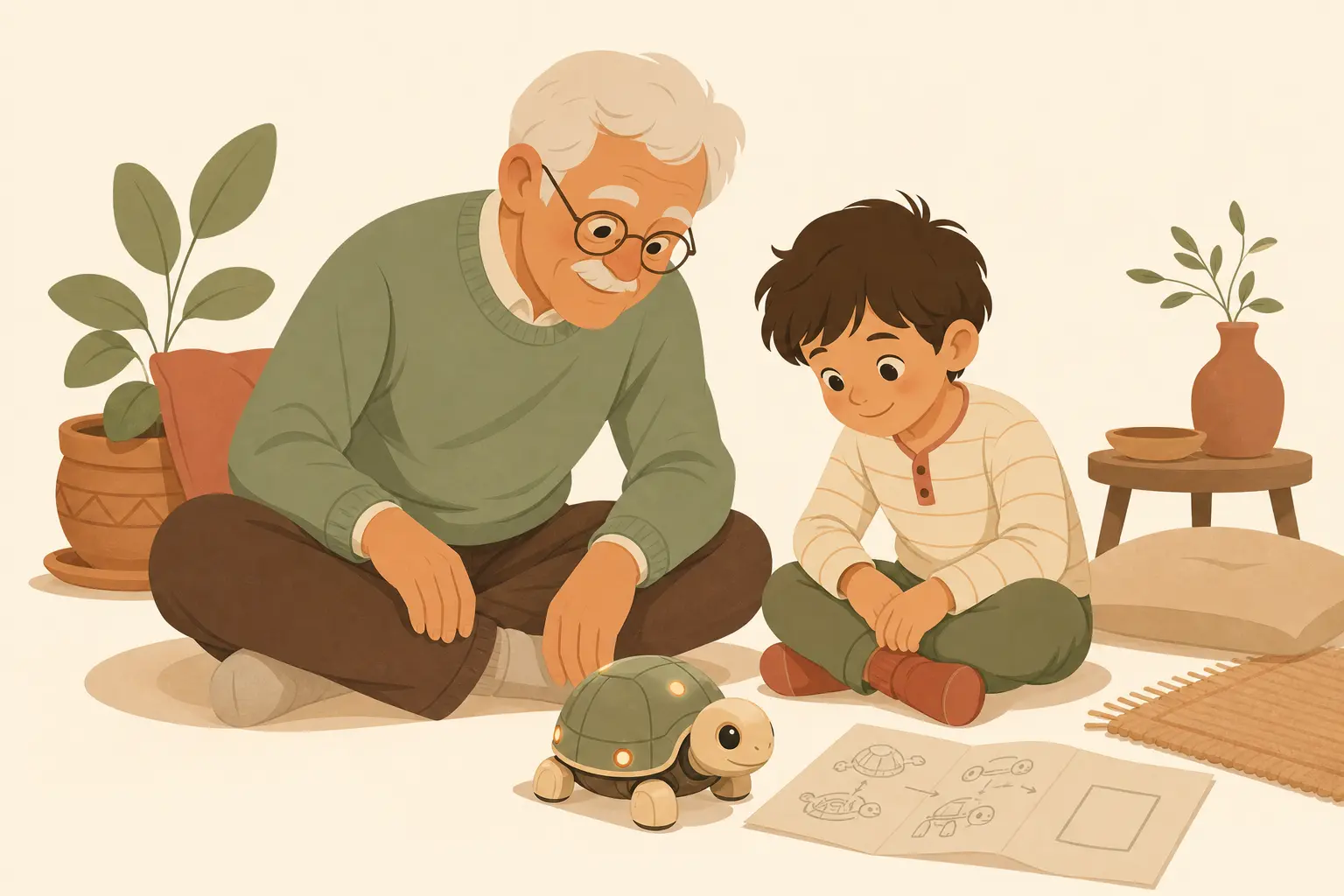
The result was Logo—the first programming language designed specifically for children. And at its heart was a small, dome-shaped robot called the Turtle.
The Turtle was not a toy. It was a thinking partner. Children could command it to move forward, turn left, turn right, and draw lines as it traveled. They could tell it: “Forward 50. Right 90. Forward 50.” And the Turtle would obey, tracing a square on the floor. Then they could make it draw a triangle, a circle, a spiral—and suddenly, geometry was no longer a set of abstract rules. It was a conversation between the child and a creature they could command.
Conventional coding classes today often teach syntax—how to type commands. But the foundational skill behind computer science is not syntax. It is computational thinking: decomposition, pattern recognition, abstraction, and debugging (Wing, 2006; Bers, 2021). The Turtle was designed to build these skills—not through typing, but through embodied, playful exploration.
Papert called this “body-syntonic reasoning”—the idea that children could understand mathematical concepts by imagining themselves as the Turtle. If you want the Turtle to draw a square, you must think like the Turtle: “I am here, facing this direction. I must move forward, then turn, then move forward again.” Your own body becomes the model for understanding.
This was the birth of computer literacy as Papert conceived it—not as the ability to use software, but as the ability to think through programming.
Game 1: The Turtle as Debugger
Take a piece of paper. Draw a simple square. Now give your child a set of instructions that draws the square, but write it wrong on purpose.
I write it like this:
- Turn right 90 degrees.
- Move forward 50 steps.
- Move forward 50 steps.
- Move forward 50 steps.
- Move forward 50 steps.
Then I give it to the child and say, “I am a robot. I will follow this exactly. No guessing.”
They immediately shout, “But you need to turn between each side!”
I say, “Then fix my code.”
And they rewrite it, step by step, adding the turns. Sometimes I do it with a physical toy turtle on the floor. I once followed their instructions to “turn right” four times in a row because they forgot to tell me to stop.
We laugh a lot. And in that laughter, they learn debugging—the most valuable skill today. Studies of debugging show it strengthens persistence and causal reasoning, because children learn that failure is information, not identity (Bers, 2021).
Key takeaway: A computer does not understand intention, only instruction.
Game 2: The Turtle as Pattern Finder
Take a piece of paper. Draw a simple square. Now ask your child: “What if I want to draw a bigger square? What changes?”
Most children will say, “Make the steps bigger.” I say, “What if I want to draw a triangle? What changes?”
Slowly they learn to see the pattern: any shape can be drawn by repeating a simple sequence. They learn that a square is “forward 50, right 90” repeated four times. They learn that a triangle is “forward 50, right 120” repeated three times.
Now give them a new shape: “Draw a spiral.” Watch them think. They will try to break it down. They will see that the pattern is “forward 10, right 90, forward 20, right 90, forward 30, right 90…” They are doing pattern recognition—learning what repeats and what changes.
This is abstraction—learning what to ignore and what to keep. It is exactly what children need to understand how AI sorts and classifies (Wing, 2006).
Make a small diagram on paper with them:
Square → repeat 4 times: [forward 50, right 90]
Triangle → repeat 3 times: [forward 50, right 120]
Spiral → repeat 10 times: [forward 10×n, right 90]
Key takeaway: Patterns are hidden structures that repeat.
Game 3: The Turtle as Decomposer
Hide a small toy in the house. Now tell your child, “I will not tell you where it is. I will only give you three exact instructions.”
You will find that “Go to the bedroom” is not enough. Which bedroom? How many steps? Turn left or right?
Help them break the big task “find the toy” into small, exact steps:
- Walk 10 steps to the hallway.
- Turn left.
- Walk 5 steps.
- Look under the blue cushion.
Now you hide it and give them instructions that have one extra, useless sentence: “Walk 5 steps, remembering that elephants are grey, then turn right.”
They will ask, “Why did you say elephants are grey?”
I say, “That was extra information. A smart thinker knows what to ignore.”
This is decomposition—breaking a big problem into small solvable parts. It is also the key to prompting AI well. A child who can decompose can guide AI; a child who cannot will be guided by it.
Key takeaway: A smart thinker knows what matters and what does not.
What Peer-Reviewed Research Shows
Unplugged computational thinking games improve logical sequencing, conditional reasoning, and debugging without requiring screen time or syntax mastery (Relkin et al., 2021). Early childhood research emphasizes that embodied, social play with caregivers builds algorithmic habits more durably than solo screen-based coding apps (Bers, 2021).
Wing’s foundational framework (2006) argues that computational thinking is a general human problem-solving habit, not just a technical skill. Teaching children to abstract, decompose, and debug in everyday contexts transfers to digital contexts later.
Papert’s Mindstorms (1980) remains one of the most influential books on educational technology. He argued that computers could liberate children from the factory model of education—if we used them to build thinking, not just to consume information.
What Parents Can Learn From the Turtle
- Protect precise language. Play robot. Follow instructions literally. Let your child fix the bug.
- Protect pattern finding. Ask your child: What repeats? What changes? What is the rule?
- Protect decomposition. Any big task (clean room, set table, draw a shape) can become three small steps. Ask: What is step one?
- Protect debugging. Let your child see you make mistakes. Let them fix your errors. Show them that failure is information.
- Protect screen-free thinking. Research shows that children think more clearly when there is no screen between them and you. They look at you, not at the glowing rectangle.
A Hopeful Conclusion
We do not need to fear that AI will write code. We should celebrate it. It frees our children from typing syntax so they can focus on thinking.
A code-user learns to obey the machine. A code-breaker learns to question it, fix it, and lead it.
When you play the Buggy Recipe or the Treasure Map tonight, you are not just making a sandwich or finding a toy. You are raising a child who will look at any intelligent system—whether a homework app or a future robot—and calmly ask:
What are the steps?
What is the pattern?
What did it leave out?
Where is the bug?
That child will not be replaced by AI. They will be the one who makes AI better. And that is a hopeful future we can build together, one game at a time.
What About You?
Have you tried teaching your child to give exact instructions? What funny bug did you discover in your recipe? Share below—we read every comment.
About the Author
Dr. Shaheen Pasha is a Professor of Special Education with over 35 years of teaching, research, and academic leadership experience. She served as Professor and Chairperson of the Department of Special Education at the University of Education, Lahore. She earned her Ph.D. in Special Education from the University of Southampton, UK. She has published more than 35 research papers and co-authored two books. Her expertise lies in child development, cognitive growth, and special education.
Dr. M. Anwar-ur-Rehman Pasha (widely recognized as Dr. M. A. Pasha) is a Professor of Computer Science with over 35 years of post-graduate teaching, research, and educational management experience. He earned his Ph.D. in Computer Science from the University of Southampton, UK in 1996. His research focuses on Artificial Intelligence, Human-Computer Interaction, and Computational Thinking. He has published two books and over 30 research articles.
Together, they bring 70 years of combined wisdom to help parents raise capable, thoughtful children in the age of AI.
References
Bers, M. U. (2021). Coding as a playground: Programming and computational thinking in the early childhood classroom. Routledge.
Papert, S. (1980). Mindstorms: Children, computers, and powerful ideas. Basic Books.
Relkin, E., de Ruiter, L., & Bers, M. U. (2021). Learning to code and the acquisition of computational thinking by young children. Child Development, 92(1), e397-e422.
Wing, J. M. (2006). Computational thinking. Communications of the ACM, 49(3), 33-35.