
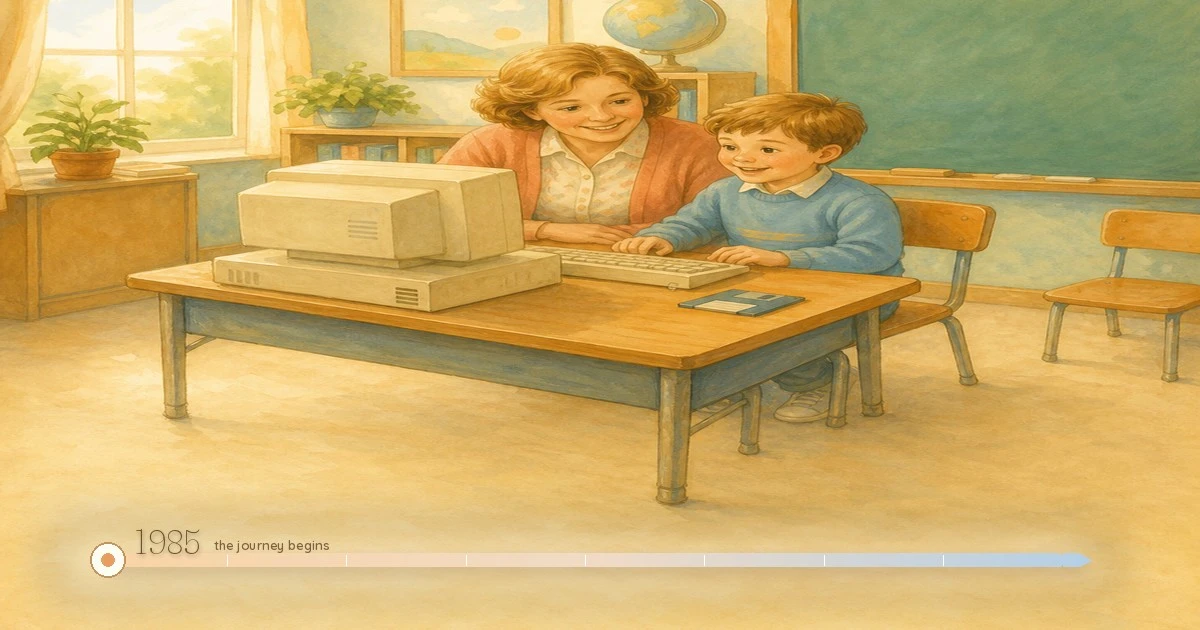
If you walked into a school in Lahore, or in Southampton where we studied, in 1986, and asked, “Is your child computer literate?”
The teacher would point to a child and say, “Yes. She knows how to switch on the computer, she knows the keyboard, the mouse, she can open a file, save a file, and print.”
That child was considered advanced.
Today that sounds almost funny. But it was not funny then. It was the first literacy for a new world.
As we begin our blog series on the evolution from Computer Literacy to AI Literacy — and the child we left behind — we must start with respect. We must understand what computer literacy was, why it mattered, and what edge it gave. Because every later literacy stands on its shoulders.
This series is part of our larger work on AI pre-literacy, a term we coined to describe the developmental foundation children need from age 2-7 before any formal literacy — computer, IT, or AI — can truly take root.
What Did Computer Literacy Actually Mean?
Computer literacy, in its original definition from the early 1980s, was beautifully simple and operational (Hawkins & Paris, 1997).
It meant five things:
1. Parts Knowledge: This is the monitor, this is the CPU, this is the floppy drive, this is the keyboard.
2. Operational Knowledge: How to switch on, how to insert a disk, how to type, how to save, how to print.
3. Software Familiarity: Knowing WordStar, Lotus 1-2-3, or later MS-DOS commands.
4. Procedural Logic: Follow steps in order — open, edit, save, close. If you miss a step, you lose work.
5. Respect for the Machine: Computers were expensive and fragile. You did not hit keys randomly. You handled them with care.
There was no internet. There was no AI. There was no search. The computer was a standalone tool, like a very smart typewriter.
Why Was That Enough Then?
Because in 1985, the edge was simply access.
A child who could operate a computer could type an assignment neatly instead of handwriting. She could save it and not retype. She could make a table for science marks. In a world where 95% of adults could not do this, that child had a visible edge in school and later in jobs (Bawden, 2001).
Computer literacy was also a mindset shift. It taught a generation of parents and teachers that the computer was not magic — it was a machine that follows instructions. If you give it clear instructions, it gives you clear results. That idea — that machines follow instructions — is still the heart of computational thinking.
What Research Tells Us About Early Computer Literacy
Early studies on computer literacy showed two important things that still matter for AI pre-literacy.
First, computer literacy reduced fear. Children who touched the machine early were less likely to see it as frightening or only for geniuses (Dyck & Smither, 1994).
Second, it introduced procedural thinking. “First do this, then do that, if this happens, do that.” This if-then structure is the seed of later coding and later AI literacy.
Dr. Shaheen Pasha remembers teaching in special education schools in England in the early 1990s. The computer with a large switch was not just a learning tool — it was a tool for access and dignity. A child who could not hold a pencil could press a switch and make something happen on screen. That was computer literacy at its most humane — giving agency.
The Edge Computer Literacy Gave — And Its Limit
The edge was clear: operational competence, neat work, saved time, future employability.
But by 1995, parents began to feel its limit.
A child could operate the computer perfectly. But could she find reliable information? Could she tell good information from bad? Could she work with others online? Could she create something new, not just type what teacher said?
Operating was no longer enough. Finding, evaluating, and collaborating became necessary.
That limit gave birth to the next literacy — IT literacy and digital literacy.
But we should not dismiss computer literacy. It gave us three gifts we still need, especially for young children:
Gift 1: The Discipline of Steps. Save before you close. Follow order. This is self-regulation.
Gift 2: The Idea of Instruction. Machines do what we tell them. That is the beginning of understanding agency.
Gift 3: The Reduction of Fear. Touching the machine early makes later literacies possible.
For children age 2-7 today, these three gifts still matter — but they are no longer about a desktop computer. They are about how a child encounters any intelligent machine. Does she poke randomly, or does she wait, watch, and follow a ritual? That waiting, that observing, is the beginning of what we now call AI pre-literacy: the emerging developmental processes through which young children encounter, make sense of, interpret, orient toward, and respond to AI-enabled agents in cognitive, linguistic, imaginative, social, emotional, behavioural, and socio-ethical contexts.
In other words, computer literacy taught a child how to encounter a computer. AI pre-literacy teaches a child how to encounter an intelligent agent — with curiosity, not fear, and with patience, not blind tapping.
What About You?
Do you remember your first computer literacy moment? The first time you saved a file, or saw your name on screen? Share below. Your story will help young parents understand that every literacy feels strange at first — and that their young child is now starting an even newer literacy journey.
This article is part of our new blog series tracing 40 years from Computer Literacy to AI Literacy — and identifying the child we left behind. It is also part of our 90-day series defining AI pre-literacy, a term coined by Dr. M. A. Pasha and Dr. Shaheen Pasha to describe the 2-7 foundation all later literacies stand on. Our pillar synthesis is here: From Computer Literacy to AI Literacy: A 40-Year Journey — And the Child We Left Behind.
About the Authors
Dr. Shaheen Pasha is a Professor of Special Education with over 35 years of teaching, research, and academic leadership experience. She served as Professor and Chairperson of the Department of Special Education at the University of Education, Lahore. She earned her Ph.D. in Special Education from the University of Southampton, UK. She has published more than 35 research papers and co-authored two books. Her expertise lies in child development, cognitive growth, and special education.
Dr. M. Anwar-ur-Rehman Pasha (widely recognized in academic circles as Dr. M. A. Pasha) is a Professor of Computer Science with over 35 years of post-graduate teaching, research, and educational management experience. He earned his Ph.D. in Computer Science from the University of Southampton, UK in 1996. His research focuses on Artificial Intelligence, Human-Computer Interaction, and Computational Thinking. He has published two books and over 30 research articles.
Together, they bring 70 years of combined wisdom to help parents raise capable, thoughtful children in the age of AI.
References
Bawden, D. (2001). Information and digital literacies: A review of concepts. Journal of Documentation, 57(2), 218–259.
Dyck, J. L., & Smither, J. A. (1994). Age differences in computer anxiety. Human Factors, 36(2), 319–326.
Hawkins, R. J., & Paris, A. E. (1997). Computer literacy and computer use in schools. Journal of Research on Computing in Education.
Papert, S. (1980). Mindstorms: Children, computers, and powerful ideas. Basic Books.