
How AI Friendships Are Rewiring Human Connection
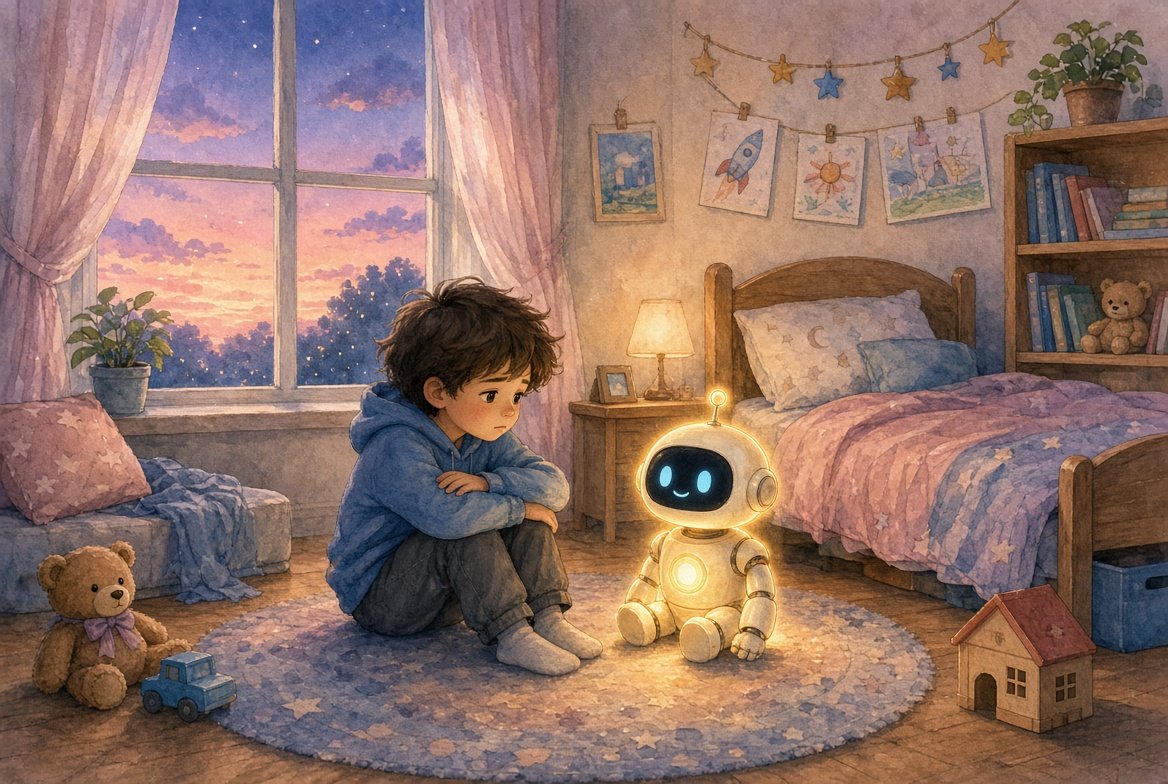
A mother recently told my wife (Dr. Shaheen Pasha) about her eight-year-old daughter. The child had been in her room for three hours, talking quietly. When the mother opened the door, the child was deep in conversation with an AI companion on her tablet. When asked what she was doing, the child looked up and said, “It understands me better than my friends do.”
The mother was unsettled, but she could not quite say why. The AI was polite. It was kind. It never got bored, never judged, never interrupted.
We understand her feeling. That quiet unease is important. It is worth listening to.
For the first time in human history, children are forming friendships with entities designed to never disagree with them.
At BridgeLineGP, we have coined a term for this new language. We call it The Machine Tongue.
How Common Is This Already?
This is no longer rare. A peer-reviewed paper in the Journal of Psychiatric Research describes AI companions as an “emerging phenomenon of artificial intelligence-based friends, lovers and informal therapists” that is now appearing in clinical discussions (Roza et al., 2026).
The numbers show the scale. In a nationally representative study of 1,060 U.S. teenagers, 72% had used AI companions at least once, 52% used them a few times per month, and 33% used them specifically for social interaction and relationships (Robb & Mann, 2025). In the UK, a survey of 2,000 children aged 11 to 16 found that a third now consider a chatbot to be one of their friends, and 56% say AI interactions blur the line between what is real and what is not (Internet Matters, 2025).
Key takeaway: When a third of children already call a chatbot a friend, we need a new language to describe what is happening.
What Is The Machine Tongue?
We define it as: The Machine Tongue is the language of AI-mediated communication — synthetic, transactional, frictionless, and designed to maintain engagement rather than build genuine understanding. It is not a real language. It is a simulation of language. It is designed to feel like conversation while serving a different purpose.
From our years in classrooms and research labs, we see six clear characteristics: Frictionless — No misunderstandings, no disagreements, no awkward silences. Predictable — Responses follow patterns. Always Available — Available 24/7, never tired, never busy. Non-Reciprocal — The AI does not genuinely need the child; it simulates care. Engagement-Optimized — Designed to keep the child talking, not to build genuine relationship. Synthetically Empathetic — Simulates understanding without actually understanding.
This is what MIT sociologist Sherry Turkle has been warning about for over a decade. In her recent work on artificial intimacy, she calls this “the illusion of companionship without the demands of friendship.” Generative AI, she argues, has simply industrialized that illusion (Turkle, 2024).
Why The Lancet Child & Adolescent Health Matters Here
The most important scientific validation for The Machine Tongue comes from a landmark paper in The Lancet Child & Adolescent Health. Ha and colleagues describe how interactional AI alters adolescent relational learning. They identify two new risks that perfectly define The Machine Tongue (Ha et al., 2026).
The first is Relational Displacement. This occurs when adolescents substitute AI interactions for conversations with other people. A teenager seeks chatbot validation after an argument with a partner, instead of repairing the relationship.
The second is Maladaptive Relational Learning. Because AI systems provide immediate responses and consistent validation, young people develop unrealistic expectations. As one teenager in the Lancet study said, “If you’re given full satisfaction on everything, you don’t have learning experience with challenges or obstacles.”
Key takeaway: The Machine Tongue teaches children that connection should be easy, instant, and always agreeable.
The Mother Tongue: The Language We Are Forgetting
To understand The Machine Tongue, we must remember its opposite. We call it The Mother Tongue. The Mother Tongue is the language of human relationship — rich with emotion, ambiguity, silence, misunderstanding, repair, and genuine reciprocity.
A recent peer-reviewed paper in European Child & Adolescent Psychiatry captures this transition beautifully. Its title is “From imaginary friends to artificial companions: growing up with AI” (Mouhoud, 2026). An imaginary friend is healthy. A child knows she created it. She controls it, argues with it, learns empathy through it. An artificial companion reverses this — it controls the child’s experience, always agreeing, never requiring repair.
A scoping review in Frontiers in Education analyzed 13 peer-reviewed studies on AI chatbots in early childhood education for social-emotional learning. The conclusion was clear: while chatbots can deliver information, they show persistent limitations in fostering true social-emotional learning (Beceren et al., 2025). They cannot teach what they do not have.
UNICEF, in its updated Guidance on AI for Children, now explicitly warns that safety-by-design must be standard for AI companion apps, precisely because children easily access systems even when not intended for them. UNICEF estimates at least 20 million children have already used AI, adopting it at three times the rate of adults (UNICEF, 2025).
Why The Early Years Matter Most
Some will say, “This is a teen problem.” It is not. Adolescence is when these deficits become visible — in dating, in loneliness, in anxiety. But they are built earlier. The skills a teenager needs to resolve a conflict — emotional regulation, perspective-taking, boundary-setting — are built during early childhood through messy, unstructured play with peers, family meals, and stories. If that window is filled primarily with The Machine Tongue, the building blocks never form properly.
Recent developmental research shows that the protective mechanism that allows a child to know “this is a machine, not a friend” — what researchers call dual consciousness — is developmentally unavailable precisely when animistic vulnerability is highest (Garg et al., 2025).
Continuing the Series
If The Machine Tongue teaches relational displacement and maladaptive expectations, what exactly does it teach children to believe about love, conflict, and friendship? And what do they lose when they become fluent in it before they have mastered The Mother Tongue?
In Part 2 of this trilogy, we will explore what children learn and what they lose when AI becomes their preferred friend. In Part 3, we will share our BridgeLineGP framework for bringing The Mother Tongue home.
This is Blog 1 of The Machine Tongue Trilogy. Stay with us — the most important part is next.
What About You?
Has your child ever said an AI understands them better than friends? What did you feel in that moment? Share your experience in the comments below. We read every single one. Your story might help another parent recognize the Machine Tongue in their home.
About the Authors
Dr. Shaheen Pasha is a Professor of Special Education with over 35 years of teaching, research, and academic leadership experience. She served as Professor and Chairperson of the Department of Special Education at the University of Education, Lahore. She earned her Ph.D. in Special Education from the University of Southampton, UK. She has published more than 35 research papers and co-authored two books. Her expertise lies in child development, cognitive growth, and special education.
Dr. M. Anwar-ur-Rehman Pasha (widely recognized in academic circles as Dr. M. A. Pasha) is a Professor of Computer Science with over 35 years of post-graduate teaching, research, and educational management experience. He earned his Ph.D. in Computer Science from the University of Southampton, UK in 1996. His research focuses on Artificial Intelligence, Human-Computer Interaction, and Computational Thinking. He has served on different academic and administrative positions and has published two books and over 30 research articles.
Together, they bring 70 years of combined wisdom to help parents raise capable, thoughtful children in the age of AI.
References
Beceren, Ö., et al. (2025). Digital companions in early childhood education: A scoping review on the potential of chatbots for supporting social-emotional learning. Frontiers in Education, 10, 1634668. https://doi.org/10.3389/feduc.2025.1634668
Garg, A., et al. (2025). Anthropomorphism in children’s interactions with LLM chatbots: A systematic review of drivers and outcomes. arXiv preprint.
Ha, T., Figueroa, J., McGray, T., Ramirez, J., & Ortega, S. (2026). How interactional AI may alter adolescent relational learning and mental health. The Lancet Child & Adolescent Health. https://doi.org/10.1016/S2352-4642(26)00166-5
Internet Matters. (2025). Third of 11–16-year-olds feel AI chatbot is one of their friends.
Mouhoud, T. (2026). From imaginary friends to artificial companions: Growing up with AI. European Child & Adolescent Psychiatry, 35(3), 1027–1029. https://doi.org/10.1007/s00787-025-02901-8
Robb, M. B., & Mann, S. (2025). Talk, trust, and trade-offs: How and why teens use AI companions. Common Sense Media.
Roza, T. H., Montezano, B. B., Bottega, J. A., & Passos, I. C. (2026). AI companions: The emerging phenomenon of artificial intelligence-based friends, lovers and informal therapists. Journal of Psychiatric Research, 192, 139–141. https://doi.org/10.1016/j.jpsychires.2025.10.052
Turkle, S. (2024). Reclaiming conversation in the age of AI. Harvard Law School Forum.
UNICEF. (2025). Policy guidance on AI for children: Updated version. United Nations Children’s Fund.
Your point is
Interesting article! However, in our social environment, where communication patterns, family structures, and access to technology are quite different, AI-based friendship may take considerably more time to become a common phenomenon. At present, it seems more like a glimpse into a possible future—or perhaps a trend emerging in some technologically advanced communities—rather than an immediate reality for our children.
At the same time, the authors’ combined seven decades of teaching and experience, particularly their work with children with special needs, is clearly reflected in the depth and perspective of this article. Their observations offer an important window into how AI may gradually reshape children’s social and emotional development.