
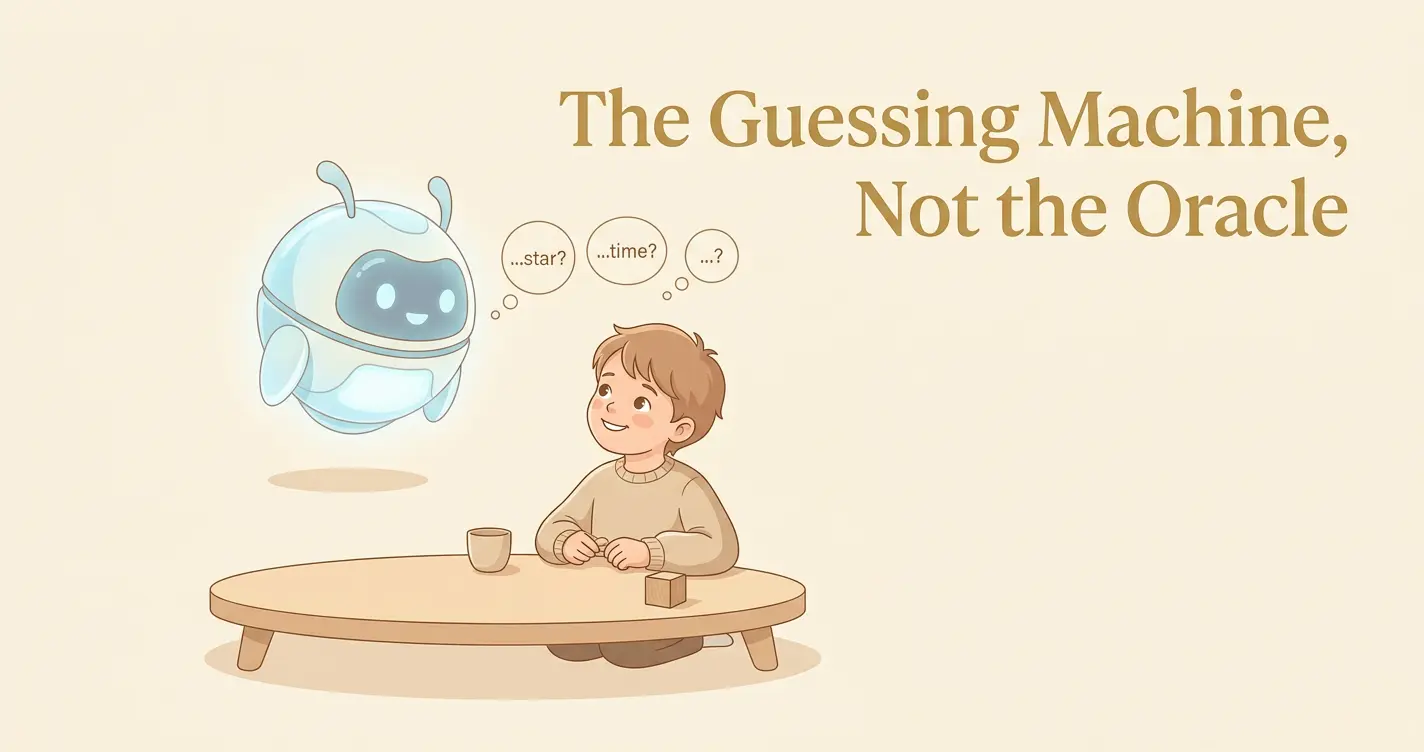
Ask a six-year-old where AI gets its answers and you will likely hear: “It knows everything.”
That belief is natural. AI answers instantly, fluently, and confidently. It never says “Hmm, I’m not sure.” For a young child, fluency feels like knowledge.
Our job is not to make AI scary. It is to make it understandable. The simplest reframe is this:
AI is not an oracle that knows. It is a guessing machine that predicts.
Why This Reframe Matters
Children develop trust by tracking confidence and accuracy. When something always sounds confident, they tend to over-trust it.
Recent reviews of AI literacy for children emphasize the same point: children need critical evaluation skills — understanding that AI systems generate likely responses based on patterns in data, not true understanding, and that they can be wrong even while sounding right.
If a child believes AI knows, they defer. If they understand AI guesses, they check.
That single shift protects what we called in the last post “epistemic agency” — the ability to judge, not just to use.
The Five-Minute Exercise: The Guessing Game
You need no app, no account, no preparation. You need a child, your voice, and maybe a phone.
Minute 1: Play the Human Guessing Game
Say: “Let’s play guess the next word.”
You say: “Twinkle, twinkle, little…”
Let your child shout: “STAR!”
You say: “Once upon a…”
They say: “TIME!”
Smile and say: “See? You are a guessing machine! You guessed the most likely next word.”
Minute 2-3: Show AI Does the Same Thing
Now open any AI or even your keyboard’s autocomplete. Type “Twinkle, twinkle, little” and let it suggest “star.”
Say: “Look, AI is playing the same guessing game. It has read millions of sentences, so it is very good at guessing what word comes next. It doesn’t know the song like you do. It guesses the pattern.”
Children get this instantly.
Minute 4: The Oops Moment (The Most Important Part)
This is where the magic happens. You need AI to get something wrong — gently and funnily.
Ask AI in front of your child: “Can you draw a dog riding a bicycle while eating ice cream upside down in space?”
Or ask: “How many R’s are in the word strawberry?” (Many models still get this wrong). Or: “Make up a story about a cat who is also my teacher Mrs. Ahmed.”
When it makes a weird, funny, or slightly wrong answer, laugh with your child, not at the tool.
Say: “Ah! Good guess, but not quite right. See? Guessing machines sometimes make silly guesses. That’s why we always check.”
This creates a core memory: AI can be helpful and wrong at the same time.
Minute 5: The New Rule
End with one simple family rule you co-create:
“We use AI to check our thinking, not to replace our thinking.”
Let your child repeat it. Put it on the fridge if you like.
What You Just Taught
In five minutes, without a lecture, you taught four things that formal AI literacy frameworks call essential:
- Data awareness: AI learns from patterns
- Critical evaluation: Guesses can be wrong
- Human agency: You are the checker
- Joyful inquiry: It is fun to question
This is what we mean by Interrogative Play — learning to dance with the question, not just demanding the answer. It protects productive struggle, the very experience AI can otherwise erase.
You have not taught your child that AI is bad. You have taught them that AI is not an oracle. And a child who knows the difference will never become an Oracle Child.
About the Authors
Dr. Shaheen Pasha — Retired Professor of Special Education. Ph.D., University of Southampton, UK. Former Chairperson, Department of Special Education, University of Education, Lahore. 35+ research papers, 2 books.
Dr. M. A. Pasha — Retired Professor of Computer Science. Ph.D. in Artificial Intelligence, University of Southampton, UK (1996). Research: AI, Human-Computer Interaction, Computational Thinking. 30+ research papers, 2 books.
Their mission: 70 years of combined academic wisdom, united to foster AI pre‑literacy in young children.
References
Atias, O., & Mawasi, A. (2025). Conceptualizing AI literacies for children and youth. Computers and Education: Artificial Intelligence, 9, 100491.
Veldhuis, A., et al. (2025). Critical AI literacy: A scoping review and framework synthesis. International Journal of Child-Computer Interaction, 43, 100708.
Note: This exercise is adapted from core principles of AI literacy education for primary school children.