
A father watched his son argue with his sister, then — without prompting — say, ‘Are you okay? I didn’t mean that.’ It was small. It was not perfect. But it was real repair. No one gave him points. His sister’s face softened. That softening was the reward.
Empathy is not taught by lecture. It is built like a muscle — through repeated, effortful, real practice where action has consequence.
After four blogs about what empathy is and what creates a vacuum, parents ask: So what do we do? This is the answer — not as tips, but as daily practices that map to the three empathies we named.
The Empathy Muscle: 5 Practices Backed by Peer-Reviewed Evidence
Practice 1: Protect Stories — For Cognitive Empathy (Thinking With Others)
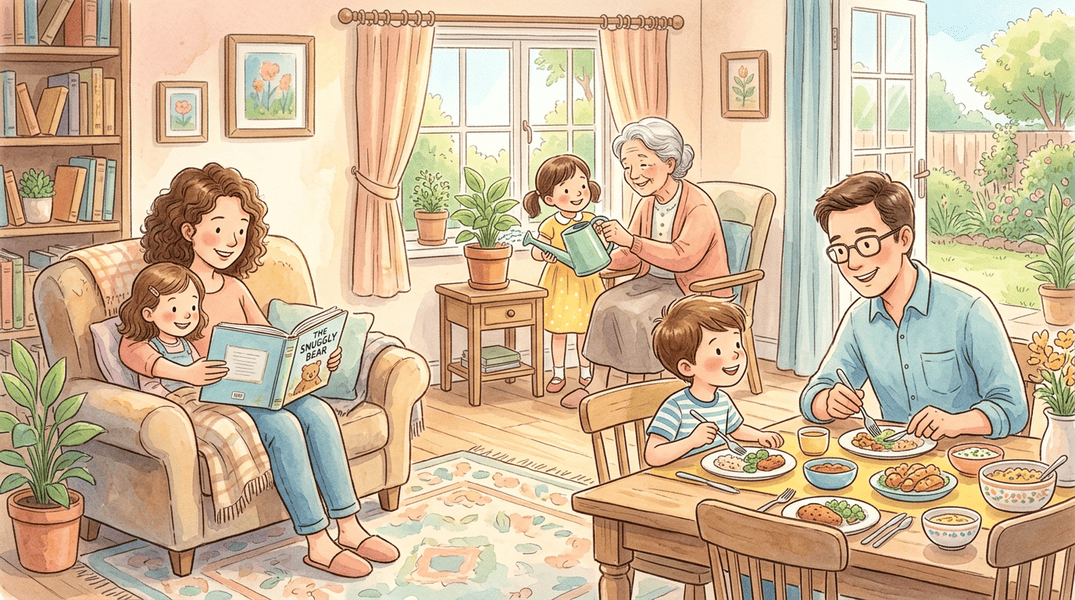
Read fiction aloud, especially literary fiction with complex characters who misunderstand each other. Pause: What does she think he thinks? Why did he do that? What does she not know that he knows? Experimental work shows reading literary fiction improves theory of mind (Kidd & Castano, 2013). Use pretend play: ‘You be the shopkeeper, I be the customer who is in a hurry.’ Pretend requires holding two perspectives at once — the foundation of cognitive empathy (Wellman, 2014).
Key takeaway: Cognitive empathy grows when a child holds two minds in mind.
Practice 2: Protect Face-to-Face — For Affective Empathy (Feeling With Others)
Protect meals with no devices. Protect looking. Play ‘What do you see in her face?’ with picture books. Research on emotion recognition training in early childhood shows explicit noticing practice improves affective empathy (Denham et al., 2003). Practice co-regulation: When your child is upset, breathe slowly yourself, stay present, say ‘I am here, we can stay with this feeling.’ Your calm body teaches more than your calm words. Parental presence itself, not just instruction, predicts development (Toledo-Vargas et al., 2025).
Key takeaway: Affective empathy grows when a child feels with, not just hears about feelings.
Practice 3: Protect Real Responsibility — For Compassionate Empathy (Doing For Others)
Give age-appropriate responsibility where a living being’s state depends partly on the child: watering plants, feeding pets, helping grandparents, setting table for family. Grusec and Davidov (2010) show domain-specific socialization — children learn prosocial behavior through real caregiving responsibilities, not just praise. Make helping a little effortful. ‘I know you are playing, but your sister needs help carrying this. You can return after.’ This teaches helping has cost and is still worthwhile. Celebrate living feedback, not points: ‘Look, the plant lifted because you watered. Grandmother smiled because you helped.’
Key takeaway: Compassionate empathy grows when helping has real cost and real consequence.
Practice 4: Protect Repair — For All Three Empathies
Human relationships rupture. Repair is where empathy is learned. Tronick and Cohn (1989) and Beebe et al. (2010) show that rupture and repair cycles build attachment and empathy. Teach a simple repair script: 1. What happened? 2. How do you think she felt? 3. What could make it better? Do it yourself first: ‘I shouted earlier. I think you felt scared. I will try to speak more calmly. Can we try again?’ AI never needs repair, so children must practice repair with humans.
Key takeaway: AI cannot be hurt, so it never needs repair. Children must learn repair with people who can be hurt.
Practice 5: Protect Boredom and Waiting — Where Empathy Grows Quietly
This is your Death of Boredom principle applied to empathy. Boredom, waiting, and not being instantly entertained create space to notice others. When every gap is filled with personalized content, there is no space to look around and ask, ‘Who might need help?’ Over-personalization reduces opportunities for cooperative skills (OECD, 2025). Protect 20 minutes daily with nothing to do — no screen, no task. Protect waiting in line without a device. It is in the gap that a child looks up and sees someone else.
Key takeaway: Empathy needs a gap — a moment not filled with ‘what’s next for me?’ where ‘what does she need?’ can arise.
A Hopeful Conclusion: You Are the Steady Mirror
AI can say, ‘I understand you feel sad.’ Only you can sit on the floor, hold your child’s hand, and let your face show you understand. AI can generate a thank-you note. Only a grandmother can smile with real relief because her grandson helped.
UNICEF (2025) reminds us children need attunement, protection, and connection to real people. You cannot filter every algorithm, but you can be the steady presence that practices empathy daily.
The distinction to teach tonight: ‘AI can tell you about feelings. But feeling with someone and helping them — that needs you, here, with your eyes and hands and heart.’
What About You?
When did your child last help without being asked? What helped them notice? Share below.
About the Authors
Dr. Shaheen Pasha is a Professor of Special Education with over 35 years of teaching, research, and academic leadership experience. She served as Professor and Chairperson of the Department of Special Education at the University of Education, Lahore. She earned her Ph.D. in Special Education from the University of Southampton, UK. She has published more than 35 research papers and co-authored two books. Her expertise lies in child development, cognitive growth, and special education.
Dr. M. Anwar-ur-Rehman Pasha (widely recognized in academic circles as Dr. M. A. Pasha) is a Professor of Computer Science with over 35 years of post-graduate teaching, research, and educational management experience. He earned his Ph.D. in Computer Science from the University of Southampton, UK in 1996. His research focuses on Artificial Intelligence, Human-Computer Interaction, and Computational Thinking. He has served on different academic and administrative positions and has published two books and over 30 research articles.
Together, they bring 70 years of combined wisdom to help parents raise capable, thoughtful children in the age of AI.
References
Kidd, D. C., & Castano, E. (2013). Reading literary fiction improves theory of mind. Science, 342(6156), 377-380.
Wellman, H. M. (2014). Making minds: How theory of mind develops. Oxford University Press.
Denham, S. A., et al. (2003). Emotional development in young children. Guilford Press.
Toledo-Vargas, M., et al. (2025). Parental technology use in a child’s presence and health and development. JAMA Pediatrics, 179(7), 730-737.
Grusec, J. E., & Davidov, M. (2010). Integrating different perspectives on socialization theory. Child Development, 81(3), 687-709.
Tronick, E., & Cohn, J. (1989). Infant-mother face-to-face interaction: Age and gender differences. Developmental Psychology.
Beebe, B., et al. (2010). The origins of attachment: Infant research and adult treatment. Routledge.
Eisenberg, N., et al. (2019). Prosocial development. Handbook of Child Psychology.
OECD. (2025). How’s life for children in the digital age? OECD Publishing.
UNICEF. (2025). Guidance on AI and children: Version 3.0. UNICEF.
Decety, J., & Cowell, J. M. (2014). Friends or foes: Is empathy necessary for moral behavior? Perspectives on Psychological Science.