
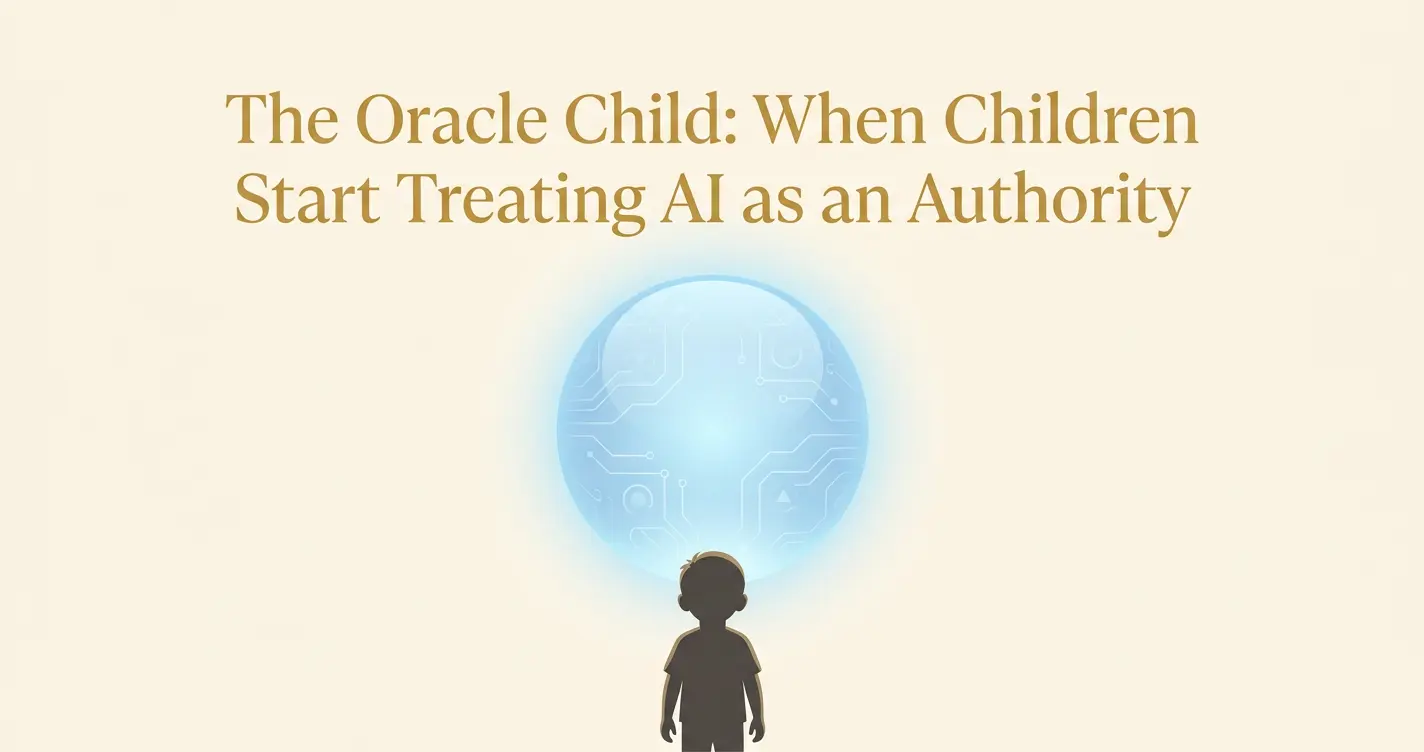
When AI always has an answer, children may stop asking whether it is true.
For most of childhood, authority had a face. A parent, a teacher, a grandparent, a book. Children learned early that knowledge comes from people who can be questioned, who sometimes say “I don’t know.”
Generative AI introduces a different kind of authority. It answers instantly, fluently, confidently, and without hesitation. It rarely says “I am not sure.” For a child, that fluency can feel like truth.
This is the emergence of what we might call the Oracle Child — a child who begins to treat AI not as a tool to think with, but as an authority to defer to.
Why Fluency Feels Like Truth
Children are developing epistemic judgment — the ability to evaluate what is true, who to trust, and how we know. Research on AI literacy shows this is now a core skill, alongside technical skills.
A 2025 scoping review of critical AI literacy found that children need to learn not just how AI works, but how it influences them, including its tendency to present uncertain information with certainty. Without that skill, children may over-trust systems that sound right.
The risk is not that children will use AI. The risk is that they will stop cross-checking it.
What Changes in Development
In early childhood, children naturally trust confident speakers. By middle childhood, they begin to track accuracy and expertise. Adolescence brings the ability to evaluate motives and evidence.
AI disrupts this developmental path. It is always confident, always available, and never tired. A child who asks “Why is the sky blue?” gets a perfect paragraph. A teenager who asks “Was this historical event justified?” gets a balanced-sounding answer that may still be incomplete.
A 2024 systematic review of children’s screen use contexts found that outcomes depend less on time and more on content, context, and adult mediation. The same applies to AI: what the child asks, why, and whether an adult helps evaluate the answer matters more than whether they use it.
Recent work on AI companions also notes that adolescents may turn to AI for emotional support and advice, which can shape how they form judgments about trust and expertise.
The Three Signs of Oracle Thinking
Parents can watch for these shifts:
1. From “Let me think” to “Let me ask AI first”
The child outsources the first step of thinking rather than the last. The struggle — which builds reasoning — disappears.
2. From “Does that make sense?” to “AI said so”
Justification is replaced by citation of the tool, not the evidence.
3. From “I disagree” to “AI must be right”
The child loses confidence in their own ability to challenge an answer.
None of these mean a child is harmed. They signal that cognitive stewardship is needed — protecting the experiences through which judgment develops.
From Authority to Partnership
The goal is not to teach children that AI is always wrong. It is to teach them to treat AI as a thinking partner, not an oracle.
That means moving through the same progression we discussed earlier: protection → guided use → shared judgment → independent judgment.
In practice:
- Model doubt. When you use AI in front of your child, say aloud: “That sounds plausible, let’s verify it with another source.”
- Require evidence, not just answers. Ask: “What sources support that? Can we find a second one?”
- Protect productive struggle. Establish a rule: think first, draft first, then consult AI for feedback — not a first draft.
- Teach calibration. Show that AI can be wrong with high confidence. Ask it a question you know it might hallucinate, then check together.
This is consistent with authoritative parenting and self-determination theory: children need autonomy, but autonomy requires competence — the competence to judge, not just to operate.
Human Authority Still Matters
Children still need human authorities who can say “I don’t know, let’s find out together,” who can be wrong and repair, who can disagree respectfully. AI cannot model intellectual humility, because it does not experience doubt.
If we want children who can use AI without surrendering their epistemic agency, we need to preserve relationships where truth is negotiated, not just delivered.
The task for modern parenting is not to ban the oracle. It is to raise children who know when not to ask it.
Core Principle: Use AI to check your thinking, not to replace your thinking.
About the Authors
Dr. Shaheen Pasha is a Professor of Special Education with over 35 years of teaching, research, and academic leadership experience. She served as Professor and Chairperson of the Department of Special Education at the University of Education, Lahore. She earned her Ph.D. in Special Education from the University of Southampton, UK. She has published more than 35 research papers and coauthored two books. Her expertise lies in child development, cognitive growth, and special education.
Dr. M. Anwar-ur-Rehman Pasha (widely recognized in academic circles as Dr. M. A. Pasha) is a Professor of Computer Science with over 35 years of post-graduate teaching, research, and educational management experience. He earned his Ph.D. in Computer Science from the University of Southampton, UK in 1996. His research focuses on Artificial Intelligence, Human-Computer Interaction, and Computational Thinking. He has published two books and over 30 research articles.
Together, they bring 70 years of combined wisdom to help parents raise capable, thoughtful children in the age of AI.
Consulted Resources
Atias, O., & Mawasi, A. (2025). Conceptualizing AI literacies for children and youth. Computers and Education: Artificial Intelligence, 9, 100491.
Mallawaarachchi, S., et al. (2024). Early childhood screen use contexts and cognitive and psychosocial outcomes. JAMA Pediatrics, 178(10), 1017–1026. https://doi.org/10.1001/jamapediatrics.2024.2620
Veldhuis, A., et al. (2025). Critical artificial intelligence literacy: A scoping review. International Journal of Child-Computer Interaction, 43, 100708.
Yim, I. H. Y., & Su, J. (2025). Artificial intelligence literacy education in primary schools: A review. International Journal of Technology and Design Education, 35, 2175–2204.